

As of September 18, 2026, Open-Weight AI Models sit in an awkward position for technical teams: accessible enough to study, adapt, and host, but difficult to secure with the same central control used by closed model providers. For a presentation audience, the story should not be framed as open equals unsafe or closed equals safe. The clearer point is operational: once weights move into many hands, safety controls, update discipline, cost planning, and evaluation practice become harder to coordinate.
Open-Weight AI Models Capability Gap
A useful briefing starts with capability, not ideology. The evidence in the research notes indicates that open-weight systems are not at parity with the most capable closed frontier systems. One analysis estimated that open models were roughly four to twelve months behind frontier closed models, with a smaller gap on public benchmarks and a wider gap on private or contamination-protected tests according to LessWrong. That range matters because a public leaderboard can behave like a scoreboard after the defense already knows the playbook.
Why Open-Weight AI Models Trail Frontier Systems
For Open-Weight AI Models, the lag is not one clean number. Public benchmarks can be trained against, rehearsed, or indirectly contaminated through data exposure. Private benchmarks and contamination-resistant tests are closer to a closed practice session: less visible, harder to optimize for, and often more revealing. A cautious presenter should show the gap as a band, not a single point estimate.
That distinction helps nontechnical stakeholders avoid two common errors. The first error is assuming that a strong open-weight model is automatically frontier-grade for every workload. The second is assuming that any measured lag makes the system irrelevant. In team terms, a player can be a step behind the league leader and still be good enough for certain roles. The adoption decision depends on the task, risk tolerance, hosting budget, and maintenance staff.
Benchmark Slides Need Caveats
Benchmark slides should separate public, private, and task-specific results. A chart that mixes them creates a false sense of precision. If the slide deck is meant for leadership, I would use a simple three-column frame: what the benchmark measures, what it misses, and how close the test is to the organization’s real workflow. This is less flashy than a single ranking, but it reduces misunderstanding.
Safety Controls That Do Not Stay Attached
The safety issue is not only whether a model has guardrails at release. The harder problem is whether those guardrails remain effective after downstream users modify, fine-tune, quantize, or redeploy the model. RUSI reported that safety training could be stripped from Meta’s Llama 3 8B in about five minutes using a single GPU for under $1, and from Llama 3 70B in under an hour in its risk analysis. That fact should be presented carefully: it is not an instruction to remove safeguards, but a signal that release-time safety controls may not be durable.
What Open-Weight AI Models Do Not Control After Release
Open-Weight AI Models create a control split. The original developer can publish model cards, recommended safety settings, acceptable-use rules, and updated releases. The downstream operator controls the copy in production. If that operator weakens safeguards or fails to apply updates, the original developer may have limited practical control over the deployed instance.
This is where the sports film-room analogy fits. A coach can hand out a playbook, but cannot guarantee how every local team runs the play once it leaves the building. The same applies to model weights. The release package may describe intended use, but the deployment environment determines runtime behavior, monitoring, logging, and access control.
| Technical Area | Supported Concern | Presentation Framing |
|---|---|---|
| Capability | Estimated lag behind closed frontier systems varies by benchmark type. | Show a range, not a single ranking. |
| Safeguards | Some safety training can be removed cheaply after release. | Separate release safety from deployment safety. |
| Infrastructure | High-end local hosting can require significant GPU spending. | Treat compute as an adoption gate, not a footnote. |
| Governance | Downstream copies can vary in patching, monitoring, and policy settings. | Map who controls each layer. |
Adoption Barriers In Production Briefings
Open-Weight AI Models can reduce licensing dependence and allow deeper inspection than closed services, but production adoption has hard edges. The research notes highlight infrastructure cost as one barrier: RUSI estimated that running a highly capable frontier open-weight model released in July 2026 on 8 B300 GPUs would involve about £220,000 to £260,000 in purchase cost, or about £31,000 to £34,000 per month to rent. Those figures make clear that “open” does not mean “cheap” once high-throughput, low-latency, secure deployment is required.
Compute Cost Changes The Decision
Cost slides should avoid treating GPUs as a single line item. The real production bill can include accelerator hardware, power, cooling, redundancy, observability, evaluation runs, staff time, and security review. Teams interested in exploring adjacent infrastructure topics might find detailed technical coverage at Techncoins. The main takeaway for a briefing is that model weights are just one part of the equation.
For small research groups, a local model can be a practical sandbox. For an enterprise group, the same model may need access controls, audit trails, incident response plans, model evaluation pipelines, and approval gates. The technical value of local control rises only if the organization can operate the system with discipline.
Maintenance Is Part Of The Model
A model selected for production becomes a maintained asset. Teams need to answer who tests updates, who reviews fine-tunes, who owns red-team findings, who monitors prompt and output logs, and who decides when a model must be replaced. Without those assignments, the deployment can drift away from the assumptions in the original safety documentation.
Security review should be defensive and operational rather than theatrical. For a related discussion of oversight gaps around open systems, see this cybersecurity review of open AI models. The useful question is not whether a model can be made perfectly safe. It cannot. The useful question is whether the team can define acceptable use, detect misuse, and respond when controls fail.
How To Present Risk Without Hype
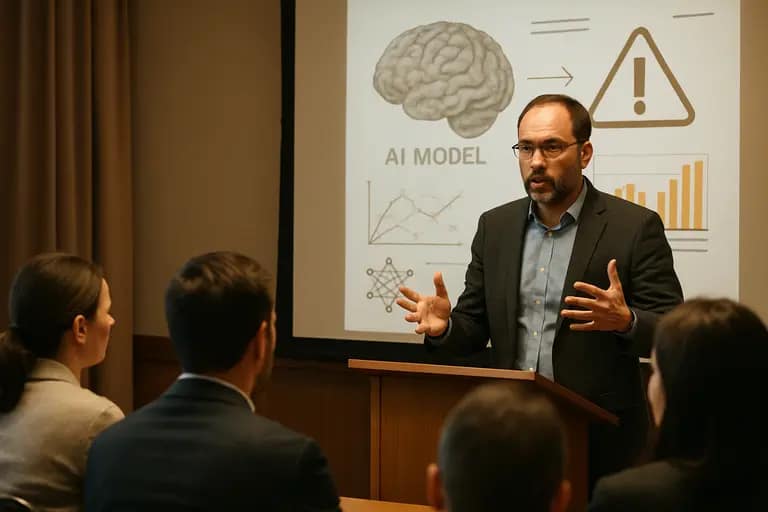
The best presentation strategy is to make the uncertainty visible. If you flatten every concern into a red warning slide, the audience may remember fear but not the technical issue. If you hide limitations in footnotes, the audience may approve a deployment without understanding the operating burden. Neither outcome helps the team.
Use A Three-Layer Slide Structure
For executive or coaching-style briefings, I recommend a three-layer structure: capability, control, and cost. Capability asks whether the model can perform the task. Control asks who can change, patch, monitor, or restrict it. Cost asks whether the organization can keep the system running safely after the first demo. This sequence keeps the room focused on decisions rather than slogans.
- Capability slide: show benchmark ranges, task tests, and known evaluation limits.
- Control slide: show which safeguards are release-time, deployment-time, or policy-only.
- Cost slide: show hardware, hosting, maintenance, and review responsibilities.
Visual design should work like a scouting report. Use one claim per slide, one supporting number where available, and one caveat that changes the interpretation. A crowded chart of model names and benchmark scores may look analytical, but it often acts like noise. A smaller chart with a clear caveat usually lands better with technical and nontechnical stakeholders.
Technical Limits Of Open-Weight AI Models
The technical case is balanced. These systems can support research access, local experimentation, inspection, and deployments where data control is a priority. They can also shift safety responsibility toward teams that may lack the budget, tooling, or staff to manage that responsibility well. The central limitation is not one defect; it is the combination of capability lag, removable safeguards, distributed copies, infrastructure cost, and uneven operational maturity.
A cautious briefing should leave the audience with a decision frame rather than a slogan. Ask whether the model is capable enough for the task, whether the safeguards survive the intended deployment path, whether the organization can afford the compute and maintenance burden, and whether governance is assigned to named owners. If those answers are weak, the risk is not abstract. It is a predictable systems-management problem that will show up after the demo, when the model becomes part of daily operations.