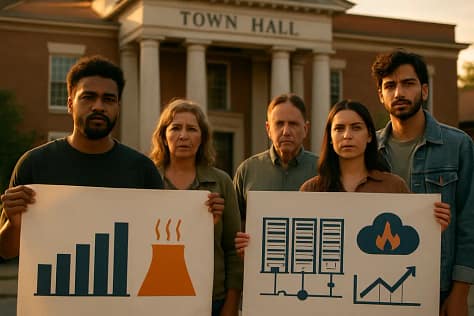
Public sentiment on data centers has shifted from background concern to a measurable delivery constraint, and data center opposition is now showing up in surveys, hearings, zoning decisions, and negotiated project limits. For delivery teams, the communication problem looks a lot like a poor halftime briefing: the room is full of numbers, but the audience is asking whether the plan helps or harms the local system.
The evidence available as of August 28, 2026 points in one direction: local acceptance cannot be assumed. Survey research in the notes shows a sharp rise in local resistance during 2026, while project-level reports show blocked, delayed, withdrawn, approved, and restricted outcomes. The technical issues behind that resistance are concrete: power demand, water use, noise, visual impact, utility cost allocation, land use, and confidence in enforcement.
This analysis keeps the claims narrow. It does not rank developers, forecast markets, or claim that every site creates the same impact. Data centers vary by size, cooling design, grid connection, backup power configuration, land use, and operating profile. Public communication should reflect that variation rather than treating every facility as interchangeable.
Data Center Opposition As A Delivery Risk
Data Center Opposition Signals
The public opinion data in the research notes shows a clear shift during 2026. A nationally representative Annenberg survey of 1,320 U.S. adults conducted from June 16 to July 19, 2026 found that 61% somewhat or strongly opposed new data centers in their local area, up from 49% in a similar March 2026 survey. The same notes report bipartisan concern: 69% of Democrats, 54% of Republicans, and 53% of independents opposed local development.
A Gallup poll conducted March 2 to March 18, 2026 also showed strong local resistance. The research notes state that 70% of Americans opposed constructing AI data centers in their area, with 48% strongly opposed and about 25% in favor. Those figures do not prove that every local proposal will fail. They do show that project sponsors and public agencies face a skeptical starting point.
From a delivery perspective, data center opposition is not only a public relations issue. It can change entitlement schedules, require new technical disclosures, create appeal risk, or lead to enforceable operating restrictions. Between April and June 2026, 20 data center proposals across 11 states worth about $98 billion were blocked or delayed amid local and state-level pushback, according to AP News reporting.
What Changed Between Planning And Approval
Many data center presentations still lead with economic development, construction activity, or compute demand. Those points may matter to some audiences, but they do not answer the questions residents tend to ask first: Will the facility raise my utility bill? How loud will it be at night? How much water will it use during heat events? What happens if promised limits are missed?
The gap is not only factual. It is also visual and procedural. A dense engineering packet may contain relevant information, yet fail as a public briefing if residents cannot see site boundaries, sound contours, utility dependencies, truck routes, cooling assumptions, or monitoring plans. In team dynamics terms, the project sponsor may think it has presented the playbook, while the public sees only a scoreboard with missing quarters.
Local Concerns Are Technical, Not Just Emotional
Power, Water, Noise, And Siting Claims
The research notes identify repeated public concerns: noise, visual impact, strain on water and power resources, elevated utility costs, environmental degradation, and possible negative effects on property values. These concerns should not be dismissed as vague resistance. Most connect to measurable design choices, operating assumptions, and local infrastructure capacity.
Power demand is a core issue because data centers can require large, steady electrical loads. The local debate often turns on who pays for grid upgrades, whether generation and transmission capacity can keep pace, and whether household or small-business customers could see indirect cost effects. Without site-specific utility analysis, broad claims about no local effect are weak.
Water is also site-specific. Some facilities use cooling systems that depend more heavily on water, while others may rely more on air cooling or different heat-rejection designs. The research notes support public concern about water strain, but they do not provide comparable water-use data for each project. That limitation matters. A credible presentation should show expected consumption ranges, assumptions, seasonal peaks, and conservation triggers rather than a single reassuring figure.
What Data Centers Do And Do Not Promise
Technically, data centers provide physical infrastructure for computing, storage, networking, and AI-related workloads. They can support services that organizations and consumers already use. That does not mean a specific facility automatically produces broad local benefit proportional to its regional impact. The local footprint is physical; many of the digital benefits are distributed beyond the host community.
This distinction is central to engagement. Residents may hear national arguments about AI, cloud services, or economic productivity, while they are being asked to accept local land-use change, industrial equipment, and utility load. A stronger briefing separates system-level function from site-level burden. It states what is known, what is modeled, what is still uncertain, and which claims will be verified after operation begins.
Project Outcomes From Local Pushback
Blocked, Delayed, Approved, Or Restricted
The research notes show that local resistance does not produce one uniform result. In Colorado Springs, the “Project Taurus” data center was approved by the planning commission as of July 2026 despite strong public opposition in hearings. In Monterey Park, Los Angeles County, a proposed 49.5-MW data center at 1977-1980 Saturn Street was withdrawn in April 2026 after strong local resistance. These cases show two different decision paths: approval after opposition, and withdrawal after opposition.
| Outcome Type | What It Means For Delivery | Evidence Needed In Public Briefings |
|---|---|---|
| Approval Despite Objections | Legal permission may proceed, but trust risk can remain. | Monitoring plans, complaint response process, and enforceable conditions. |
| Delay Or Appeal | Schedule certainty drops and carrying costs may rise. | Clear answers on utilities, land use, cooling, and noise modeling. |
| Withdrawal | The sponsor may abandon or redesign the project. | Record of unresolved technical or political objections. |
| Settlement With Restrictions | The project may continue under operating limits. | Specific caps, reporting duties, and local service commitments. |
The Saline Township Pattern
Saline Township, Michigan rejected a proposal in Spring 2025 to build a large data center on 250 acres of farmland. The developer sued the town, and by fall 2025 a settlement allowed development with restrictions on water use and commitments for local public services, as described by The Washington Post.
That sequence is useful because it shows how a project can move from rejection to litigation to conditional acceptance. For public agencies, the lesson is not that opposition always stops a project. For developers, the lesson is not that lawsuits solve trust problems. The practical point is narrower: unresolved technical concerns can become legal and political constraints, and late-stage negotiation often produces conditions that could have been discussed earlier.
Engagement Tactics For Evidence-Based Briefings

Build The Meeting Like A Decision Review
Public meetings often fail because they are built like sales presentations. A better structure resembles a coaching review: define the field, show the constraints, identify risk, and explain how performance will be measured. That approach is less theatrical, but it respects the audience’s need to test the plan.
- Start with the site: Show parcel boundaries, nearby homes, substations, water sources, road access, and visual buffers.
- Separate measured data from modeled estimates: Label what is known today and what depends on final equipment, load, or operating mode.
- Use ranges where evidence is uncertain: Single-point claims can sound precise without being reliable.
- Show accountability: Explain monitoring, reporting frequency, complaint handling, and enforcement triggers.
- Connect benefits and burdens locally: Avoid only national or regional claims if local residents carry site-level effects.
For those interested in infrastructure and delivery concerns across the technology sector, Techncoins.net provides detailed analysis within the same network. This approach emphasizes starting with a clear system boundary before presenting a claim to the audience.
Use Visuals That Reduce Ambiguity
Visual communication can either calm a room or inflame it. A map with no scale, a sound chart with unexplained units, or a water-use number without seasonal context can feel evasive even if technically accurate. In contrast, a clear sequence of visuals can help residents see which impacts are modeled, which are regulated, and which remain uncertain.
For data center opposition, the most useful visuals are not decorative. They are decision aids: load diagrams, water-flow summaries, noise contour maps, construction phase timelines, emergency access routes, and before-and-after site sections. Each should answer one question. If a slide needs a long verbal defense, the slide is probably doing too much.
The presenter should also avoid overclaiming certainty. Early designs may change after interconnection studies, equipment selection, cooling design, or permit conditions. A cautious briefing says that clearly. Trust is easier to preserve when uncertainty is named before opponents find it.
Data Center Opposition And Local Sentiment
Data center opposition should be treated as a technical engagement signal, not just a political obstacle. The 2026 survey figures in the research notes show that many Americans object to local siting even while broader views on AI remained steady between spring 2026 and the June-July 2026 Annenberg survey period. That distinction matters: residents may not be rejecting digital infrastructure in principle; they may be rejecting poorly explained local risk.
The strongest public briefings will be specific, visual, and bounded by evidence. They will show what the facility does, what it does not do, what the site demands from local utilities, and how impacts will be measured after approval. They will also admit where data is incomplete. In a tense room, that kind of candor is not a weakness. It is the difference between presenting a finished score and showing how the team plans to defend every possession.