
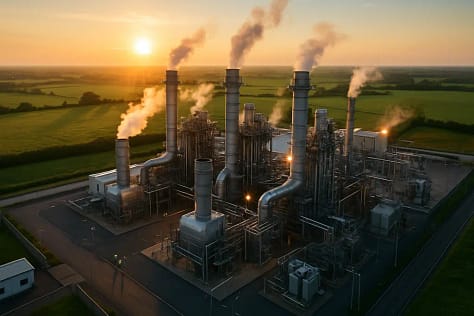
Pennsylvania Gas Power is becoming a sharper test of how a state balances electricity demand, reliability, emissions, and clean energy targets. The latest reporting cited in the research points to a projected natural gas power capacity increase of about 15% by 2030, with data centers named as a major demand driver. That does not make the outcome automatic. It does mean clean energy planning has to work like a disciplined team meeting: separate the scoreboard from the strategy, identify what changed, and be honest about tradeoffs.
What Pennsylvania Gas Power Growth Changes
The most direct technical change is capacity planning. A reported 15% increase in gas power capacity by 2030 would add a sizable dispatchable resource to a grid already using natural gas heavily. Axios reported that Pennsylvania gas power is projected to grow 15% by 2030, with rising electricity demand from data centers as a central factor Axios. That projection matters because capacity additions can influence transmission needs, fuel delivery, emissions profiles, and the pace at which lower-carbon resources are integrated.
For clean energy, the issue is not simply whether gas plants can produce electricity. They can. The harder question is whether new gas capacity fills short-term reliability gaps without locking in higher emissions and infrastructure commitments for longer than intended. A coach would ask: is this a temporary formation change, or are we rewriting the playbook?
Pennsylvania Gas Power And Data Demand
Data center demand creates a planning challenge because it can be large, concentrated, and sensitive to uptime. The research notes identify data centers as a key reason for the projected buildout. That pressure is not unique to Pennsylvania, but the state’s generation mix makes the effect more visible. For a related technical discussion of facility demand and grid limits, the site’s analysis of data center energy growth covers similar stakeholder tensions.
Behind the numbers sits a communication problem. Utilities, regulators, developers, and communities may be using the same word, “reliability,” while meaning different things. A data center operator may mean near-continuous power quality. A grid planner may mean resource adequacy across peak hours. A community may mean fewer outages without worsening local air quality. Those definitions need to be made explicit before project benefits and costs can be compared fairly.
The Existing Generation Baseline
The baseline is already gas-heavy. The U.S. Energy Information Administration reported that natural gas supplied 57% of Pennsylvania’s monthly electricity generation in October 2024, and that the state’s natural gas consumption for electricity doubled from 2013 to 2023 EIA data. That historical shift limits how clean energy implications should be framed. This is not a state moving from zero gas dependence to gas dependence. It is a state considering more gas capacity on top of an already large gas role.
That distinction matters for emissions accounting and infrastructure risk. If new gas generation runs often, it can increase fuel consumption and associated carbon dioxide emissions. If it runs rarely, it may still require capital spending, interconnection work, pipeline capacity, and maintenance. Either way, the clean energy effect depends on actual operating patterns, not nameplate capacity alone.
Clean Energy Pressure Points
Clean energy progress is shaped by what new gas plants displace, what they delay, and how they are operated. If gas generation substitutes for coal, some air pollutants can decline depending on plant controls and operating conditions. If it substitutes for renewables, storage, demand response, or efficiency, the emissions profile looks different. The research supplied for this article does not provide plant-by-plant dispatch modeling, so any claim about net emissions must be treated cautiously.
The same caution applies to reliability claims. Dispatchable power can support grid operations, but reliability is not produced by fuel type alone. Transmission constraints, generator availability, pipeline deliverability, heat waves, cold snaps, maintenance cycles, and interconnection queues all affect performance. A new gas plant may help under one constraint and do little under another.
Emissions And Local Air Quality
Gas plants emit carbon dioxide during combustion, and they can emit nitrogen oxides and other pollutants depending on equipment and controls. The research notes raise concerns about nitrogen oxides, particulate matter, ozone precursors, and health impacts tied to new gas generation serving data centers. Because the underlying modeling details are not included in the allowed source set, this article should not repeat the most specific health estimates as settled fact. The supported analytical point is narrower: more combustion-based generation can increase emissions unless offset by reduced generation elsewhere, stronger controls, or lower operating hours.
For clean energy planning, this means policymakers need more than capacity totals. They need expected annual generation, heat rates, emissions controls, fuel supply assumptions, and retirement schedules for older units. A slide with “15% growth” is the headline. The real scouting report is how many hours those plants run and which resources they push off the field.
Policy Choices And Constraint Management
Policy design can change the result. Carbon rules, clean energy standards, permitting requirements, interconnection reforms, efficiency programs, and demand response can all shape whether new gas capacity becomes a bridge, a backstop, or a long-lived emissions source. The research notes refer to the Regional Greenhouse Gas Initiative as a possible counterpoint, but the exact legal and implementation status is not established in the allowed source set here. The defensible point is that emissions caps and market rules can materially affect dispatch incentives.
A useful test is whether policy asks gas projects to prove a system need that cannot be met at lower emissions and reasonable cost. That does not rule out gas. It raises the evidence threshold. Clean energy planning works best when every resource, including gas, storage, renewables, efficiency, and demand flexibility, is compared against the same reliability need.
Who Is Affected By The Buildout

The affected groups are not all evaluating the same risk. Data center operators may prioritize speed to power and uptime. Utilities may focus on resource adequacy and interconnection logistics. Gas producers and pipeline operators may see higher throughput needs. Communities near proposed plants may focus on air quality, water use, noise, land use, and tax revenue. Clean energy developers may see interconnection competition or market price changes.
This is where strong communication matters. A sports leader would not walk into a locker room with one metric and expect alignment. The same applies here. Stakeholders need a shared dashboard showing demand forecasts, capacity additions, retirements, emissions, local pollution controls, cost allocation, and uncertainty ranges. Without that shared view, each group can claim the data supports its position while avoiding the tradeoffs.
- Grid planners need hourly demand and generation assumptions, not only annual projections.
- Communities need clear permitting data, emissions limits, monitoring plans, and complaint processes.
- Clean energy developers need interconnection clarity and market signals that reflect reliability value.
- Large power users need to show whether demand can be shifted, reduced, or paired with lower-carbon supply.
Technical readers may also track wider infrastructure coverage through resources offered by Techncoins, which provides a spectrum of material on technology and energy topics. The key is to keep the analysis grounded in measured demand, verified capacity plans, and enforceable operating rules.
Pennsylvania Gas Power Clean Energy Tradeoffs
The clean energy implication of Pennsylvania Gas Power growth is not a single verdict. It is a set of conditional outcomes. If new gas capacity runs frequently and slows lower-carbon resources, emissions risk rises. If it operates as a limited reliability resource while storage, transmission, efficiency, and clean generation expand, the effect could be more contained. The difference depends on policy, dispatch, project design, and demand management.
The supported facts are enough to justify close scrutiny: Pennsylvania already relies heavily on gas for electricity, gas use for power rose sharply from 2013 to 2023, and reporting on October 13, 2026 pointed to about 15% projected growth by 2030. Those facts do not settle the debate, but they set the agenda. Clean energy planning now has to answer a practical question: how much new combustion capacity is truly needed, under which operating limits, and with what safeguards for emissions, costs, and communities?
That question should be handled with the same discipline as reviewing game film. Do not praise a play because it looks strong on paper. Test it against the opponent, the clock, the injury list, and the score. For Pennsylvania, the “score” is reliability, affordability, emissions, and public health. Any gas buildout that claims to support clean energy progress should be judged against all four, using transparent data rather than slogans.