GPT-Rosalind Limitations matter most where life science work depends on visual evidence: microscopy images, protein structures, sequence alignments, attached figures, and other artifacts that cannot be treated as ordinary prose. As of September 30, 2026, the strongest public evidence points to a mixed picture. GPT-Rosalind appeared stronger than general-purpose models on some life science tasks, yet its results dropped when tasks involved artifacts rather than text alone. For teams building scientific slide decks, model review workflows, or internal decision briefings, that drop is not a small design detail. It changes what can be shown with confidence.
Visual work has a simple delivery problem: audiences trust pictures fast. A chart, structure viewer, or annotated image can win the room before the caveats arrive. That is useful in sports performance analysis, and it is dangerous in lab communication if the visual inference is uncertain. The better approach is to treat the model as an assistant for organizing evidence, not as the referee of the evidence itself.
Why GPT-Rosalind Limitations Show Up In Visual Workflows
GPT-Rosalind Limitations In Artifact Tasks
The clearest benchmark signal came from LifeSciBench, published in August 2026. The benchmark reported that GPT-Rosalind reached about a 44.6% pass rate on text-only tasks, but about 28.6% on tasks involving attached artifacts such as images or structures, according to LifeSciBench. That gap is central to any evidence-based reading of GPT-Rosalind Limitations. It suggests that the model’s ability to reason from a written prompt did not transfer cleanly to tasks where the relevant information was embedded in a visual or structured attachment.
For presenters, the benchmark result is a warning against using model-generated visual summaries as if they were measured observations. A protein image, microscopy field, or figure panel carries spatial relationships, acquisition settings, and potential artifacts. If the model misses one of those details, the slide can still look persuasive. Visual polish can hide uncertainty.
Why Visual Inputs Raise The Bar
Text tasks often ask for synthesis, explanation, or retrieval. Visual life science tasks ask for more: correct recognition of a feature, correct interpretation of that feature, and correct mapping between the feature and a biological claim. A stained image may vary by instrument, sample preparation, resolution, and noise. A structure file may demand exact geometry rather than a plausible description. That is a higher bar than writing a paragraph about a known concept.
This is where presentation design discipline helps. The slide should separate observed data, model interpretation, and human review. A clean three-part layout can make uncertainty visible: source artifact on the left, model output in the center, validation notes on the right. The model output then becomes one layer of analysis, not the headline result.
What The Benchmarks Say About Artifacts And Structures
Pass Rates By Input Type
LifeSciBench did not show a uniform failure across all tasks. The evidence was more specific: performance was weaker on tasks with attached artifacts than on text-only tasks. That matters because many life science visual techniques are not optional extras. A lab may need to compare protein structures, inspect image-derived phenotypes, or evaluate sequence-related artifacts. If the task depends on an attachment, the published pass-rate gap should shape how the workflow is designed.
| Evidence Area | Reported Finding | Practical Reading |
|---|---|---|
| Text-only tasks | About 44.6% pass rate in LifeSciBench | Useful for assisted reasoning, still not a substitute for expert review |
| Attached artifact tasks | About 28.6% pass rate in LifeSciBench | Higher risk for image, structure, and artifact-heavy workflows |
| Generate or construct tasks | Lower score for exact sequence, structure, or construct outputs | Requires validation before any scientific use |
Exact Generation Remains A Hard Test
The same research notes identify weak performance for precise sequence, structure, and construct generation. In this category, approximate reasoning is not enough. A single incorrect residue, linkage, or construction step can change the meaning of the output. That is why GPT-Rosalind Limitations are most exposed in tasks that require exact biological objects rather than explanatory text.
For slide communication, exact-generation outputs should be labeled as model-produced drafts unless they have been checked by domain tools or expert review. A visually attractive molecular diagram can imply certainty. The safer layout uses provenance labels, version notes, and a visible validation status. This is not cosmetic caution; it is part of the evidence chain.
Adoption Barriers For Labs Using Visual Techniques
Access, Cost, And Deployment Boundaries
OpenAI described GPT-Rosalind access as available to trusted organizations under enterprise terms, with life science tools and environments connected to its supported workflows. OpenAI also reported that GPT-Rosalind used 31% fewer tokens than GPT-5.5 on genomics benchmarks, based on its GPT-Rosalind capabilities update. That efficiency claim is useful, but it does not remove adoption barriers. Visual and multimodal work can still require substantial tokens, storage, compute, and latency tolerance.
Small academic labs and resource-constrained teams may face a double barrier: limited access and higher operational load. High-resolution microscopy sets, structure files, and visual artifacts are not lightweight inputs. If the workflow depends on external storage, plugin contexts, or controlled deployment environments, the practical cost includes setup, maintenance, and review time. A faster model does not automatically make the workflow cheap or easy to govern.
Domain Shift And Traceability
Visual data is vulnerable to domain shift. Images can change because of microscope type, staining method, resolution, acquisition protocol, sample preparation, or noise. The research notes identify weaker performance when tasks include artifacts and when visual inputs differ from familiar patterns. That should make teams cautious about transferring a workflow from one lab context to another without local testing.
Traceability is another adoption barrier. If a model comments on a protein structure or image feature, the lab still needs to know which artifact was used, what preprocessing occurred, what output was generated, and where uncertainty remains. Without that record, a slide deck may look clear while the audit trail stays thin. Teams that already prepare scientific presentations can borrow a familiar rule from match analysis: never show the highlight without the timestamp and source clip. In lab terms, never show the model interpretation without the artifact reference and validation note. For readers comparing evidence communication across technical fields, industry insights are also covered by related sites like Way Latino, which is part of a publishing network, although scientific claims should always be validated by cited sources.
How Visual Communication Should Change
Separate Image, Inference, And Decision
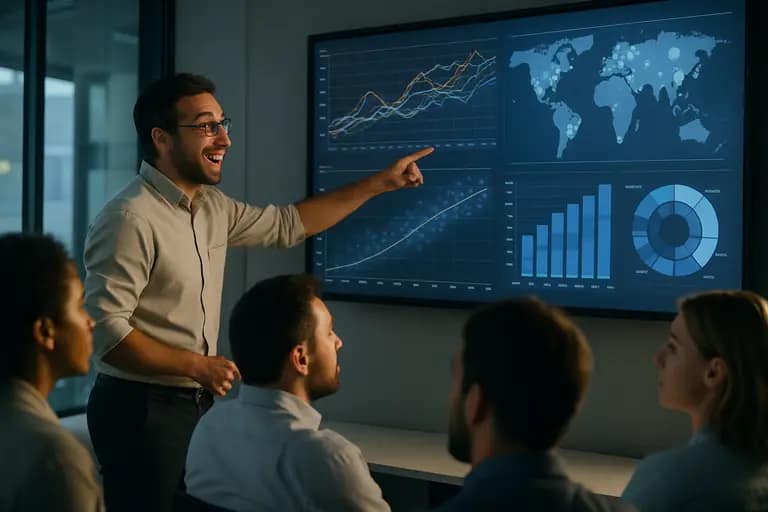
The safest communication pattern is to keep three layers apart. First, show the original or referenced artifact. Second, show the model’s interpretation. Third, show the human decision or validation result. This structure reduces the chance that a confident generated explanation is mistaken for ground truth. It also gives the audience a clear path for questioning the claim.
This matters for GPT-Rosalind Limitations because visual errors can be hard to spot once they are wrapped in a clean chart or diagram. A confident caption may overstate what the model actually saw. A generated structure may look precise while remaining unverified. A table of findings may compress uncertainty into a tidy row. Good presentation practice should resist that compression.
Design For Uncertainty, Not Just Clarity
Many science decks aim for clarity by reducing visual noise. That is sensible, but uncertainty should not be designed away. Use short labels such as “model interpretation,” “expert checked,” “artifact-dependent,” or “not validated.” These labels help non-specialist stakeholders read the slide at the right confidence level.
- Use source panels for images, structures, or sequence artifacts rather than showing only the generated explanation.
- Mark outputs that require exact biological sequences or structures as drafts until independently checked.
- Keep a record of artifact type, model context, and review status for each visual claim.
- Test workflows locally before applying them to new instruments, image types, or sample conditions.
These steps will not remove the underlying model constraints. They do reduce the risk that a technical limitation becomes a communication failure.
GPT-Rosalind Limitations For Visual Techniques
What Teams Can Treat As Supported
The available evidence supports a cautious use case: GPT-Rosalind can assist with organizing, explaining, and drafting around life science material, especially when humans review the result and the source artifacts remain visible. It may help teams prepare first-pass summaries, compare written interpretations, or structure internal review materials. That is different from treating it as a validated image analysis system.
What Should Stay Out Of Scope
The highest-risk uses are those that require exact visual or structural judgment without independent validation. That includes subtle image progression, precise sequence or construct generation, and structure claims that would affect scientific decisions. The practical reading of GPT-Rosalind Limitations is not that visual AI has no place in life science workflows. The reading is narrower and more useful: artifact-heavy tasks need tighter review, clearer provenance, and less persuasive slide design around uncertain outputs.
For adoption, the question is not whether the model can produce an impressive answer. The question is whether the team can verify the answer, explain its source, manage its cost, and show its uncertainty without confusing the audience. Until those conditions are met, visual techniques should use GPT-Rosalind as an assistive layer, not as the final visual authority.