All posts by Gladys Lee

Using Impactful Visuals in Coach Presentations: From Diagrams to Animations

Ever given a great game plan, only to see it forgotten by your team? It’s not your strategy’s fault. It’s how our brains work.

We live in a world where images are key, as sociologist Lester said. Understanding comes from reading images, not just words. For coaches, this means turning a tactic into something truly understood.

Remember your last film session? Was it your words or the visuals that made everyone go “aha!”? Studies show that using graphics with your voice boosts retention sixfold.

Research finds 83% of learning is visual. We remember 10% of what we hear but 80% of what we see and do. Your presentation should be an experience, not a lecture.

Ignoring effective visual aids is like running a marathon in uncomfortable shoes. It’s possible but not efficient. Let’s improve your coaching tools.

Types of Visuals (Diagrams, Charts, Animation, Infographics)

Choosing the right visual for your coaching presentation is key. It’s not about what’s trendy, but what fits your message best. Think of it as building a team with unique skills for different tasks.

Diagrams and charts are your go-to tools. A good presentation diagram is like Shakespeare for sports. It makes complex plays simple and clear for everyone.

Infographics are like data journalists. They show stats and tell the story of a player’s growth or a team’s strategy.

Animation and video are the big guns. They grab attention and make information stick in our fast-paced world. Sports animations make complex ideas pop in busy feeds.

A 30-second animation can show a perfect jump shot better than words. It’s like explaining gravity with an apple. Modern sports animations make abstract ideas real.

Don’t forget live tools like graphic recording. They turn strategy sessions into illustrated epics. Whiteboards and flip charts add that raw energy slides sometimes miss.

Your visual arsenal includes:

  • Diagrams & Charts: The foundational language of strategy
  • Infographics: Data storytelling at its most persuasive
  • Animation & Video: Emotional and cognitive engagement multipliers
  • Live Tools: Whiteboards, graphic recording for spontaneous collaboration

The magic is in matching the tool to the task. Use presentation diagrams for basics. Infographics for data points. Save sports animations for those big “aha” moments.

This isn’t about picking one thing over another. It’s about having the right visual for every team conversation.

Effective diagrams, animations, and graphics work because they translate complex ideas into something players can instantly understand. Exploring why visuals matter in sports presentations helps coaches recognize how visual communication strengthens learning, retention, and tactical clarity during team meetings.

Choosing the Right Tool

Visual aids in sports aren’t for everyone. Picking the wrong one is like using a football in tennis. Even the best animation can’t save a talk that’s too complex.

Start by figuring out what you need. Are you explaining a new defense to freshmen? An animated video might be perfect. Or, if you’re showing season stats to athletic directors, a detailed infographic is better.

Choosing the right visual aid depends on its purpose. Do you want to shock, inspire, or just inform? Your visuals should match the mood of the room.

Think of your audience like a coach scouting opponents. Are they visual learners or do they love data? The setting also matters. A big auditorium needs different visuals than a small team meeting.

AI can make videos, but it can’t connect with people like humans do. For a key pre-game talk, do you want generic animation or something that shows your team’s spirit? Humans create real connections, which are key in coaching.

Choosing the right tool means picking the right person to make it. Sometimes, a simple whiteboard diagram is better than fancy animation. Your decision should depend on what you’re trying to say.

Tool Type Best For When to Avoid Human Touch Needed
Animated Video Explaining processes, showing movement, emotional storytelling Data-heavy presentations, quick stat reviews, low-budget projects High – requires narrative craft and emotional resonance
Infographics Data summarization, comparison displays, quick visual reference Step-by-step instructions, emotional appeals, live demonstrations Medium – design matters, but data integrity is key
Charts & Graphs Statistical analysis, trend visualization, performance metrics Conceptual explanations, motivational talks, non-technical audiences Low – tools can generate, but interpretation needs expertise
Live Diagrams Interactive sessions, tactical adjustments, real-time collaboration Polished final presentations, large audiences, archival materials Very High – depends on presenter’s skill
Photo Collages Emotional connection, team building, culture showcases Technical instruction, data presentation, process explanation High – curation needs emotional intelligence

The best visual aids in sports mix purpose with personality. An infographic for boosters is different from one for players. Animation for recruitment is different from animation for technique correction.

My rule is simple: If you can’t explain in one sentence what the visual does for your message, don’t use it. “This animation shows how our defense rotates” is good. “This looks cool” is not.

Tools are meant to enhance, not create. Choose based on what needs to be amplified—clarity, emotion, or data. Your audience will appreciate it more than applause.

Integrating Video & Live Demonstrations

Think of video in your presentation like a cameo in a film. It’s exciting when it fits the story, but annoying when it doesn’t. Video can make your presentation engaging, but only if used right.

Good video is like a before-and-after clip. It shows how to do something better. It turns simple coaching visuals into powerful examples.
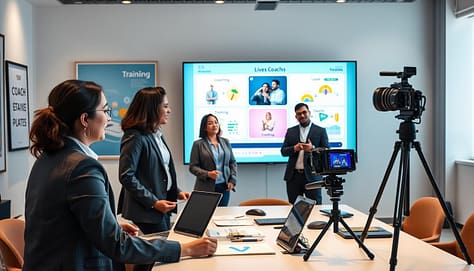
A dynamic coaching environment showcasing the integration of video and live demonstrations. In the foreground, a diverse group of three professional coaches, dressed in business attire, engages with a large interactive screen displaying animations and training diagrams. In the middle ground, a sleek presentation area is visible with a tabletop filled with coaching materials, a laptop, and a camera capturing live demonstrations. The background features a modern conference room adorned with motivational posters and soft lighting that creates an inspiring atmosphere. The image is bright, highlighting the vibrant colors of the visuals on the screen. Use a slightly elevated angle to capture all elements harmoniously, conveying a sense of teamwork and innovation in coaching presentations.

Always explain why you’re showing a video. Tell your audience what to look for. For example, “Watch how the sales rep handles an objection at 15 seconds.”

This helps keep their focus. Whether it’s a “training video production” or a “new hire video,” make it relevant. Show only what’s needed and mention its length. This shows respect for their time and keeps your story moving.

Live demos are like a high-wire act. They’re exciting but risky. When introducing new equipment, avoid passing it around.

This can split the audience’s attention. Instead, move slowly and explain clearly. Reveal the object after setting the stage with words. This turns a simple demo into a lesson in focus.

Now, let’s talk about live graphic recording. Imagine drawing a complex plan in real-time. This makes coaching visuals more than just pictures. They become a shared understanding.

This method, or “graphic recording,” makes workshops interactive. It turns listeners into part of the story. The diagram changes as you all work together, capturing ideas and questions.

So, when should you use these tools? Here’s a simple guide:

  • Use video for proof and emotion: A “sales enablement” video or a “corporate video” showing culture. Keep it short and focused.
  • Use live demos for novelty and tangibility: Show physical tools or software features. Keep everyone’s attention.
  • Use live graphic recording for complexity and collaboration: Map out plans or solve problems together. Create presentation diagrams as a team.

The magic happens when these elements are part of your presentation. Your video becomes a case study. Your demo proves your point. Your diagram is a shared understanding. This is more than just presenting. It’s creating a shared experience.

Audience Interaction Techniques

The most dangerous slide in any presentation isn’t the one with confusing data—it’s the one that turns your team into glassy-eyed spectators. We’ve all seen it: the coach talking at a screen while players mentally rehearse their dinner orders. The goal isn’t exhibition; it’s intervention. Your visuals should demand a response, a choice, a physical or mental action.

Let’s start with the oldest tech in the room: the whiteboard. Your body language here is part of the visual aid. Don’t talk to the board like it’s your confessor. Write one key point, then turn and face the jury. As the research suggests, this simple pivot changes everything. You’re not lecturing; you’re testifying. Keep it to one main idea per sheet—clutter is the enemy of engagement.

Now, the humble handout. Most coaches distribute them like party favors at the end. Wrong move. Hand them out at the beginning, but here’s the twist: leave strategic blanks. Provide partially completed diagrams of your new defensive scheme. Suddenly, players aren’t just holding paper; they’re holding a puzzle they need your voice to solve. This marries auditory and visual learning—they must listen to fill the gaps.

Want to level up? Borrow from the digital world’s “interactive explainer” concept. These aren’t just videos; they’re conversion machines that turn passive viewers into active participants. How do you translate this to the field house?

  • Live Polls: Use a quick, anonymous phone-based poll. “Which coverage gives us the most trouble against spread offenses?” Display the growing bar chart in real time. You’re not just asking for opinions; you’re visualizing consensus.
  • Player Diagrams: Ask your quarterback to come up and diagram his read on the blitz package. The whiteboard becomes a collaborative space, not your personal canvas.
  • Graphic Recording: Have an assistant sketch key points as you speak on a large pad. It’s live infographics creation—the team watches strategy become art.

This is where sports animations shift from show-and-tell to ask-and-answer. Don’t just play a clip of the new motion offense. Pause it at the critical moment. “Where does the weak-side linebacker go here?” Make them predict before revealing the solution. You’ve transformed a monologue into a dialogue.

The same principle applies to static infographics. Instead of presenting a completed chart of season statistics, show it with missing data points. “Based on what you saw last quarter, what number belongs in this red zone efficiency slot?” The image becomes a question, not just an answer.

Think of your meeting space. When you use these techniques, the energy transforms from lecture hall to war room. Pens scratch. Heads tilt. Questions fly. The best sports animations aren’t the most technically perfect—they’re the ones that get someone to point at the screen and say, “But what if we…” That’s the moment you’ve won. You’re no longer presenting to your team. You’re thinking with them.

The tools are simple: a board, some paper, a phone, a purposeful pause. The shift is profound. From passive consumption to active construction. Your playbook comes alive not when it’s printed, but when it’s debated, drawn, and dissected by the people who will execute it.

Professional Presentation Design

In today’s coaching world, amateur design is like showing up in flip-flops. It shows you didn’t prepare well. Good design for your coaching visuals means making things easy to understand. It’s about removing obstacles between your idea and your team’s grasp.

What is professional design? It’s not Comic Sans or a 3D exploding pie chart. It’s not a background that makes you feel sick. These are not just bad looks; they block understanding.

So, what are the must-do’s? Think of them as your design guide:

  • Font Size is Law: Use 24pt text at least. If someone in the back can’t read it, you’ve lost them.
  • One Idea Per Slide: Your slide should focus on one thing. Let it stand out.
  • Animations With Purpose: Use motion to show sequences or direct attention. Avoid random animations.
  • Font Fidelity: Stick to one or two typefaces. Your presentation isn’t a font show.
  • Data Visualization: Choose simple graphs over flashy ones. Clarity wins over complexity.

Color is key. It boosts motivation and memory. But, use it wisely, not wildly.

Tools like the Adobe Color Wheel help coaches create good color schemes. They make your visuals look cohesive and professional.

Remember, design for color-blindness. A red vs. green chart might confuse some. Always check contrast and use patterns or labels as backups. It’s inclusive and ensures your message reaches everyone.

Your background should support your content, not steal the show. Use a simple color or texture. Keep the focus on your message, your visual aids in sports.

This discipline is more important than ever. We’re surrounded by AI graphics that lack soul. Clean, human-centric design lets your coaching voice shine. It shows you value your audience’s time and effort.

For more on creating effective visuals, check out this ultimate guide. It explains the psychology behind good design.

Professional design for your visual aids in sports is about respect. Respect for your message, your audience, and the art of communication. It turns your presentation into a clear, memorable experience that inspires action.

Showcasing Success Stories

What do a global music streamer and a high school football coach have in common? More than you might think. Both deal with the big challenge of reaching many minds. When Spotify trained 4,000 employees in 17 countries, they didn’t just send out emails. They made engaging, multilingual video modules. This led to scalable understanding across the board.

This move from theory to action is key. Your strategy isn’t just a guess. It’s a system that needs to be proven. Visual success stories are the proof you need.

A dynamic sports animation scene showcasing a triumphant coach leading a diverse team of athletes in a celebratory moment. In the foreground, the coach, dressed in professional sports attire, raises a trophy high above their head, surrounded by excited team members in matching uniforms, all expressing joy and camaraderie. In the middle ground, focus on animated visual elements like action lines and motion graphics representing their journey and achievements. The background features a vibrant sports arena filled with cheering fans, colorful banners, and bright lights illuminating the scene. Use a wide-angle lens to capture the energy and excitement, with soft, glowing hues to evoke a feeling of success and inspiration. The atmosphere is exhilarating and uplifting, reflecting the essence of sports triumph.

Think about the Michelin paradox. How do you sell tires in a country with no cars? You don’t focus on the tires themselves. Instead, you publish the Michelin Guide, full of travel and food content. You become the go-to expert, not just a salesman.

For a coach, your “Michelin Guide” is a visual success story. It’s an animated review of last season’s big win. It’s a diagrammatic breakdown of how your defense beat the top team. These aren’t just replays. They’re your visual tools for selling your team’s culture and discipline.

This content does the hard work for you. It answers the “why” before anyone even asks. A well-made sports animations success story video turns abstract ideas into something emotional and memorable. It creates a shared story. This is how we succeed here. This is what resilience looks like on film.

Corporate Case Study Core Principle Coaching Application Visual Tool
Spotify’s global video training Scalable, consistent messaging Onboarding new players to team systems Animated playbook modules
Michelin Guide content marketing Building authority, not just selling a product Establishing a “winning culture” philosophy Documentary-style season recap videos
Sales enablement toolkits Providing ready-made proof for persuasion Convincing athletes to buy into a new strategy Interactive presentation diagrams of opponent weaknesses
Change management animations Making abstract change tangible and positive Implementing a new offensive scheme Side-by-side animation comparing old vs. new play execution

The table is more than just a list. It’s a guide for translating ideas into action. The world’s top communicators use visuals to tell stories and prove points. Your team room should be no different. Ditch the hypothetical. Use documented reality to prove your points. Let your success stories, shown in clear presentation diagrams and dynamic sports animations, be the most convincing slides in your deck.

Resources for More

Having a vision is one thing, but finding the resources to make it happen is another challenge. You want to create a PowerPoint playbook that looks like a Marvel story. But where do you start? The wise one doesn’t send you on a journey without preparing you.

There are many resources available if you know where to look. Start with guides that explain the animation process. Learning each step helps you understand your role better. You’ll be able to communicate your coaching vision clearly.

Then, look for lists of key animation techniques. Knowing the difference between motion graphics and character animation is important. It helps you choose the right tool for your coaching messages.

Finding the right production partner is also key. Look for someone who values human connection over just content output. The best partners will ask about your team’s culture before discussing details. They see your playbook as a source of inspiration, not just information.

Building your own collection of visual aids in sports is important too. Save and bookmark examples of effective infographics and animations. This will be your go-to collection when you need inspiration.

  • Production Guides: Step-by-step breakdowns of scripting, storyboarding, and animation pipelines
  • Technique Libraries: Visual dictionaries of animation styles from kinetic typography to 3D simulation
  • Partner Directories: Vetted studios specializing in athletic and educational content
  • Template Repositories: Starting points for sports-specific infographics and data visualizations

Learning from each project is the most valuable resource. You’ll discover what works best for athletes. Keep the infographics and animations that help, and analyze those that don’t.

Start curating today, one image at a time. Your future self will thank you for a visually stunning playbook. The right infographics and animations don’t just explain the game. They become part of your team’s visual language, fueling commitment and clarity.

Step-by-Step Example

Imagine you’re a coach with a new defensive scheme to teach on Monday. Time is short, and your team’s minds are already full. That’s when coaching visuals become essential. Let’s go through this step by step.

Your goal is more than just to present. You aim for deep understanding for the game. Your team thinks in movements, not words. A simple speech won’t do.

Step 2: Select the Tool Mix (The “What”)

You need a variety of visuals, not just one. Choose based on your goal:

  • An Animated Diagram: A quick loop showing the whole scheme. It gives a big-picture view that static images can’t.
  • Static Presentation Diagrams: Clear handouts for each player’s role. They’re like cheat sheets for later.
  • A Live Whiteboard Session: The interactive space. Here, theory meets the next week’s opponent.

This table shows the purpose and benefits of each visual tool:

Visual Tool Primary Purpose Key Design Principle Integration Point
Animated Diagram Show dynamic movement & holistic scheme Use team colors & clean motion paths Opening “wow” to establish concept
Static Handout Diagrams Provide individual role clarity & reference One key point per page, large symbols Distributed after animation for annotation
Live Whiteboard Facilitate adaptation & collective problem-solving Keep it simple; encourage staff to draw Final workshop for opponent-specific tweaks

Step 3: Create with Design Rules (The “How”)

Now, add the finishing touches. The animation uses your team’s colors for familiarity. Arrows are thick and clear. The background is simple, with no clutter. The handout presentation diagrams are even simpler: one key assignment, one large jersey number, one clear symbol. They’re like visual haikus.

Step 4: Plan the Integration (The “When”)

The order matters. You don’t just throw coaching visuals out there. You plan them carefully.

  1. Start with the animation. It’s the hook, providing the elegant “aha” of the entire system.
  2. Pause. Distribute the handouts. Ask your staff to circle their specific focus area. You’ve just made them active participants.
  3. Move to the whiteboard. “Okay, now how do we adjust this against Team X’s spread offense?” You draw, they suggest, you refine together.

Step 5: The Outcome (The “So What”)

This is the magic. You don’t get polite nods masking confusion. You get smart questions. “If the wingback pushes here, does my linebacker follow or stay?” The question itself proves they see it. You’ve built a shared visual language. Comprehension isn’t a hope; it’s visible in their annotations and their suggestions on the board.

The right presentation diagrams and animations didn’t just explain a play. They turned your staff into co-creators of the game plan. That’s the power of moving beyond words.

Conclusion

Why do great ideas often disappear? The answer lies in the visuals, not just words. Our minds are wired to process images better than text. A diagram or animation stays with us, while words fade away.

This journey was about making communication more powerful. Visual aids make our messages clear and engaging. They turn listeners into viewers, making them more active.

In sports, every detail matters. Using sports animations and infographics can make complex data easy to understand. These tools are not just for looks; they help our brains grasp information better.

Your presentations should be more than just talks. They should be visual experiences. By combining what you say with what your audience sees, you can win their minds. So, grab your digital tools and create something that will stick with them.

How to Adapt Sports Presentations for Youth and Adult Teams

I’ve faced tough crowds before. Some were executives who barely looked up from their watches. Others were young people who seemed bored, constantly checking their phones.

The problem was always the same. I was talking to no one in particular. I was broadcasting, not connecting.

This isn’t about making things simple for everyone. It’s about knowing your audience. Their age group tells you how to reach them.

Trying to speak to everyone the same way is a mistake. It’s important to think about who you’re speaking to. What would grab your attention if you were in their shoes?

Understanding how to talk to people of different ages is key. It’s like switching from old-school radio to a popular video on social media. Even with great content, the wrong way of presenting it can fall flat.

Understanding Youth Needs vs. Adult Expectations

The gap between Baby Boomers and Gen Z is not just about tech. It’s also about how they think. To talk to each group well, you need to understand their hidden rules. Adult teams follow rules from a time of loyalty and clear paths. Youth teams, on the other hand, are all about speed and being real.

Baby Boomers see work as a promise. They’ve worked hard for stability and respect. They value knowing the system well and clear lines of authority. Gen Z interns, though, see work as a service they can cancel if it’s not good.

It’s not about right or wrong. It’s about different ways of thinking. Generation X likes to be left alone to solve problems. Older Millennials want to learn and find meaning in their work.

Youth teams are different because they’re always growing. They question rules to learn and find who they are. They’re building their identities online and in real life.

For adult teams, you need to explain the big picture. For youth teams, be real and guide them like a coach. They can tell when you’re just pretending. Designing inclusive sports presentations helps coaches adapt their message so that both younger athletes and experienced players can clearly understand and engage with the material

The table below shows the main differences. It helps you understand the different generations in today’s teams.

Generational Cohort Core Expectation from Work/Presentation Primary Currency View on Authority
Baby Boomers Mutual loyalty, recognition for legacy Experience & Institutional Knowledge Respect formal hierarchy
Generation X Autonomy, efficiency, no-nonsense approach Independence & Problem-Solving Hands-off; prove your competence
Millennials Purpose, coaching, continuous learning Growth & Meaningful Contribution Prefer mentor/coach dynamic
Generation Z Transparency, pragmatic utility, skill advancement Digital Pragmatism & Adaptability Question to understand; value authenticity over title

When you’re getting ready to talk, think about who you’re talking to. Are you speaking to those who built the system or those learning to use it? It’s not about pleasing everyone. It’s about using the right language for your audience.

Slide & Visual Design by Age Group

Think of your slide deck as a mood board for your argument. Its visual elements like fonts, colors, and images speak volumes before you say a word. For adult teams, this means being credible and structured. For youth teams, it’s about being fast and interactive.

A modern office setting filled with diverse individuals engaging in a presentation, with a focus on visual learning techniques tailored for youth and adult teams. In the foreground, a young woman in smart casual attire interacts with a vibrant digital display showcasing colorful infographics, illustrations, and engaging visuals that depict key concepts of communication design. In the middle ground, an adult man in professional business attire stands beside a traditional whiteboard adorned with age-appropriate design elements. The background features a sleek conference room with soft, natural lighting pouring in from large windows, creating a warm and inviting atmosphere. The overall mood is collaborative and dynamic, highlighting the effective use of visuals in communication tailored for different age groups.

Adults, often Gen X and Boomers, value clarity and authority. Your deck should look like a well-organized legal brief. Use clean templates and serif fonts like Garamond to convey trust and tradition.

Data is key, presented in elegant charts that show trends and ROI. Bullet points are used to build a logical story. This approach is concise and allows for deep analysis, showing credibility. Research on communication across age groups shows that youth teams, mostly Gen Z and younger Millennials tend to prefer visual, fast-moving digital content compared with older generations.

For youth teams, mostly Gen Z and younger Millennials, your deck should be dynamic. Use bold, sans-serif fonts and emojis to add emotional tone. Visual metaphors are better than dry explanations.

Images should be engaging, like memes or short videos. Use design cues from gaming, like progress bars and icons. This makes the slides easy to understand quickly. Variety is key to keep interest high. A slide shouldn’t stay the same for more than 20 seconds.

The table below shows the difference in design for adult and youth teams. It’s like comparing a Harvard Business Review article to a top YouTube essay.

Design Dimension Adult Teams (The Legal Brief) Youth Teams (The Instagram Story)
Core Design Ethos Credibility & Depth. Projects authority and facilitates deep analysis. The slide is a reference point. Engagement & Velocity. Prioritizes immediate understanding and emotional connection. The slide is an event.
Typography & Text Serif fonts (e.g., Garamond). Concise, full-sentence bullet points. Ample white space for a “clean” feel. Bold sans-serif fonts (e.g., Montserrat). Minimal text, keyword-driven. Emojis for tone and quick visual cues.
Data Presentation Complex charts (line, bar, scatter plots) telling a story of causality and return. Footnotes are acceptable. Simplified, bold infographics. Icon-based statistics. Progress bars and donut charts for instant comprehension.
Imagery & Media High-quality professional photography, formal logos. Embedded video is used sparingly, usually as full-length case studies. Memes, GIFs, user-generated content aesthetic. Short, viral-style video clips (under 30 sec). Dynamic animations.
Interactive Elements Q&A periods, rhetorical questions posed to the group. Slides are mainly for speaker support. Live, embedded polls (Mentimeter, Slido). Quizzes with instant feedback. Direct calls-to-action in chat or on social media.

This isn’t about making content simple for youth or boring for adults. It’s about translation. You’re adapting the same message for the visual language your audience understands. For adults, it’s about hierarchy and proof. For youth, it’s about sensation and shareability. Mastering both languages lets you communicate effectively with your audience.

Presentation Tone and Engagement Strategies

If your slides are the movie, your tone is the soundtrack. Nobody wants elevator music in an action film. This is where tailoring messages becomes real. Your voice’s pace, pitch, and personality can open doors or build walls.

For adult professionals, think of Malcolm Gladwell and a TED Talk moderator. Your tone should be confident and measured. It’s analytical but narrative, weaving data into story arcs. The goal is to facilitate insight, not entertain.

With youth, think of a creator’s livestream. Your tone should be relatable and direct, like Hank Green. It should be faster, confessional, and include cultural touchstones they recognize. The question isn’t “What’s the ROI?” but “Why should I care?”

Consider these tonal adjustments as switching broadcast frequencies:

  • Adult Frequency: Lower, steadier pace. Wry humor that nods to shared experience. Q&A as intellectual tennis.
  • Youth Frequency: Higher energy with intentional pauses. Self-deprecating humor that builds trust. Q&A as collaborative brainstorming.

Source 2’s “Motivating the Listener” questions become your cheat sheet. Adults want to know how it affects their bottom line. Youth need to see its relevance to their world.

Engagement isn’t one-size-fits-all. For boardrooms, try the “challenge premise” technique. For classrooms, use digital tools like quick poll apps.

The tips from Source 1 are survival tactics. “Know Your Audience” means recognizing what works. “Not Working? Try Something Else” is the permission to change your approach.

Most critically, practice active listening. Read the room’s body language. Your ability to adjust your presentation is key to tailoring messages effectively.

Adults need to be convinced of your credibility. Youth need to feel you’re authentic. Your tone bridges that gap.

Stretch yourself. Set mutual expectations early. Be truthful about what you know and what you’re learning. That authenticity, wrapped in the right vocal package, turns monologues into conversations every time.

Storytelling and Real-Life Examples

Why do stories about perseverance resonate with adults but not teens? It’s because of cultural differences. Adults might think of Steve Jobs in a garage as proof that hard work pays off. Teens, on the other hand, might look to TikTok creators or Minecraft teams for the same lesson.

This is all about framing. It’s about making your story fit into your listener’s world.

A vibrant and engaging scene depicting a diverse group of professionals presenting concepts tailored to different age groups. In the foreground, a young adult in a smart casual shirt gestures enthusiastically, showcasing a digital tablet filled with colorful infographics and relatable real-life examples, while an older colleague in professional attire nods in agreement. In the middle ground, a round table is surrounded by team members of varying ages, with expressions of curiosity and understanding, actively discussing ideas. The background features a bright, modern office with large windows letting in natural light, creating an inviting atmosphere. The composition uses a warm color palette to convey approachability and engagement, with soft focus on the background to highlight the central discussion. The mood is collaborative and informative, celebrating effective communication through storytelling.

Think of it as choosing the right examples. You need to pick examples that are relevant to your audience. This way, you avoid stereotypes and make your message clear.

Adults value proven expertise and institutional navigation. Their stories often involve climbing corporate ladders or managing big projects. These stories show a path of gradual growth.

For teens, the stories are about rapid iteration and community leverage. They see success in startups that listen to feedback or artists who grow their fanbase through daily posts. Teens value authenticity and speed over polish.

Let’s talk about how to choose the right examples. The table below shows how to adapt your stories for different audiences while keeping the core message the same.

For example, when discussing branding or team identity, you might highlight how organizations strengthen loyalty through items like custom branded promotional merchandiseservices. These examples help illustrate how teams connect with their communities and reinforce their message through consistent visuals and shared identity.

Using relatable examples like this helps audiences understand the broader concept. Instead of abstract explanations, your presentation shows real-world applications that resonate with both adults and younger audiences.

Core Concept For Youth Teams (The Narrative Code) For Adult Teams (The Narrative Code)
Teamwork & Coordination A perfectly timed raid in Destiny 2 or a collaborative mod-building project in Roblox. Roles are fluid, communication is constant, and the goal is clear. A cross-departmental project launch or a successful client negotiation. It’s about aligning different silos, managing stakeholder interests, and executing a plan.
Innovation & Problem-Solving Using a viral Twitter thread to crowdsource a solution, or a hackathon where a functional app is built in 48 hours. Implementing a new enterprise software system that streamlines old processes, or developing a long-term R&D pipeline.
Leadership & Influence A streamer building a respectful and engaged community, or a project lead on a fan-made game who motivates volunteers. A manager who mentors reports into promotions, or a director who gains buy-in for a risky but necessary strategic shift.
Resilience & Learning from Failure A video game developer publicly patching a flawed game based on player rage, or a creator whose “cringe” early work becomes a celebrated part of their journey. A product launch that initially flopped, leading to a much more successful Version 2.0, or a career pivot after an industry downturn.

The moral of the story remains the same—”work together,” “be innovative,” “lead well,” “bounce back.” But the setting changes. This is what adapting presentations for different ages is all about.

Your story about teamwork isn’t about a boardroom. It’s about a coordinated raid. Your lesson on innovation isn’t about a lab. It’s about a hackathon. You’re not changing the truth. You’re just speaking the narrative language your audience already understands and trusts.

Workshop Activities

Forget trust falls and awkward icebreakers. Today’s audiences want activities that really diagnostic teeth. The right exercise doesn’t just break the ice; it melts it to reveal what’s lurking beneath the surface. Think of these as strategic probes disguised as play.

For adult teams, we’re past simple role-plays. We need sophisticated simulations that validate their hard-earned experience while stretching their strategic muscles. Consider a competitive business model canvassing session where teams tear apart and rebuild each other’s proposals—it’s like Shark Tank meets group therapy.

Or try a “pre-mortem” exercise: before a project begins, have them collaboratively predict every possible failure point. It’s morbidly fun and brutally effective. Ethical dilemma debates based on real corporate scandals (Theranos, anyone?) force teams to articulate values under pressure.

These activities work because they treat adults like the experts they are, while creating spaces for cross-pollination between departments and perspectives. The goal isn’t just learning; it’s revealing hidden assumptions and building collective intelligence.

For youth teams, the calculus changes completely. They’re digital natives who expect to make things, not just discuss them. Your activities must be project-based, product-oriented, and leverage their comfort with collaborative tech.

Think rapid prototyping: give them a social media problem and 30 minutes to design a solution using whatever apps they normally use. Or have them create a mini-podcast episode summarizing key learnings—suddenly they’re editors, narrators, and sound engineers.

My personal favorite? A collaborative meme-creation contest to encapsulate a complex idea. It sounds silly until you see how efficiently it forces distillation of concepts into shareable communication. These aren’t distractions; they’re engagement engines.

Activity Type Adult Team Focus Youth Team Focus Core Skill Developed
Strategic Simulation Business model analysis, risk assessment Social problem-solving, digital prototyping Critical thinking & collaboration
Creative Production Executive summary, proposal writing Podcast, video, meme creation Communication & digital literacy
Performance & Debate Ethical dilemma discussions, panel debates Talent shows, poetry slams, presentations Public speaking & argumentation

Planning these experiences requires intentional design for collaborative learning. Vocabulary-building shouldn’t feel like homework—embed it in the activity’s success criteria. Need to promote speaking? Skip the stiff presentations and opt for plays, talent shows, or poetry contests where expression takes center stage.

For reading and writing, games are your secret weapon. A “greatest hits” activity where teams rewrite dense policy documents as tweet threads or Instagram captions teaches conciseness through cultural translation. Another winner: a collaborative story-building game where each participant adds one sentence, building narrative while practicing written cohesion.

The through-line for all these workshop activities? Moving participants from passive consumers of information to active co-creators of understanding. For adults, it’s about leveraging their experience. For youth, it’s about channeling their digital fluency into tangible outcomes.

Your workshop isn’t a break from the presentation—it’s where your message gets stress-tested by the only judges that matter: the people in the room. Design according.

Inclusive Communication Model

We’ve talked about the differences between youth and adults. But what about introverts, neurodivergent individuals, and those who feel overwhelmed? The best age-appropriate presentations don’t just connect different ages. They also welcome everyone, no matter their mind type.

Inclusivity is about how we communicate, not just who we are. It’s like moving from a one-way conversation to a story where you choose your path. Your goal is to create a space where everyone can find their way in.

This idea is called the “presentation omnichannel.” It says that everyone learns differently. Some need the slides early, others want a live transcript, and some like to click on polls. And some need time to think about ideas later.

This model is built on respect and flexibility. It values different ways of participating. It offers many solutions, not just one. It also listens to feedback and changes as needed.

For some, listening is hard. They might have conditions that affect how they process language. That’s where tools like live captioning and communication devices help. They make things more accessible. We just need to use them.

The table below shows how to adapt presentations for different needs. It’s a guide for making presentations that work for everyone.

Audience Need Common In… Presentation Adaptation Tech/Tool Example
Extra Processing Time Neurodivergent thinkers, non-native speakers, reflective learners Share slides 24+ hours in advance; provide post-session digital summary Email deck; shared Google Doc recap
Kinesthetic Engagement Youth groups, hands-on learners, ADHD profiles Embed interactive polls, Q&A breaks, or quick “turn-and-talk” moments Mentimeter, Slido, Kahoot
Auditory/Visual Support Hard of hearing, auditory processors, visual learners Use live auto-captioning; complement speech with consistent on-screen keywords Otter.ai, PowerPoint live captions
Low-Pressure Participation Introverts, anxious attendees, hierarchy-conscious teams Offer anonymous feedback channels; use small breakout rooms instead of whole-group calls Anonymous Google Form; Zoom breakout rooms
Assistive Communication Non-verbal individuals, those with speech disabilities Incorporate AAC (Augmentative & Alternative Communication) principles; allow text-based responses Chat functions, speech-to-text apps

Notice the pattern? You’re not just making one presentation. You’re creating a whole system with many parts. The live event is just the start. The prep work, interactive parts, and follow-up materials are key too.

This approach is the highest level of adaptation. It respects big trends while also valuing individual differences. A shy teenager needs different support than an outgoing one. A senior with dyslexia needs different materials than their colleague.

When you master this model, you stop wondering if people liked your presentation. You start wondering how many ways people connected with your ideas. This shift from being a one-way broadcaster to a system builder is what makes communication truly inclusive. And it’s what defines the next generation of age-appropriate presentations.

Case Study Comparisons

The real test of a communication strategy isn’t in the slides. It’s in the stories people remember. These stories depend on who’s listening. Let’s look at a common problem: introducing a new digital privacy policy.

For your adult teams, you’re talking to different generations. Boomers value tradition, Gen Xers want the quick summary, and Millennials like to work together. A good example is Siemens’ long journey with GDPR. It shows how to handle legal rules, get everyone on board, and roll out changes step by step.

This approach makes change seem like a strategic marathon. People are interested in the how, not just the what.

Now, think about your youth teams, mostly Gen Z and young Millennials. They live in a fast-paced digital world where trust is key. The same privacy policy needs a different approach. A viral TikTok star losing her platform due to a privacy mistake could be the key story here.

This story shows the quick backlash, lost trust, and how she rebuilt with clear data practices. It makes the policy about personal brand survival, not just rules.

There’s a big difference. One is like a corporate movie, the other a social media thriller. Both teach the same lesson, but one gets a nod of approval, the other sparks real understanding and agreement.

Looking at generations, a movie like The Program works for older audiences. It’s a deep look at system manipulation. For younger people, a fast-paced documentary on influencer culture collapse might be better. The message is the same, but the way it’s told matters a lot.

Dimension Case Study for Adult Teams Case Study for Youth Teams
Narrative Style Process-oriented, historical, analytical. Personal, immediate, community-focused.
Core Appeal Strategic foresight, risk mitigation, proven methodology. Authenticity, social capital, rapid adaptation.
Primary Channel In-person briefing, detailed report, webinar. Short video, social post, interactive chat.
Key Takeaway Change is a complex journey we can manage. Change is a present reality we must navigate to stay relevant.
Generational Resonance Appeals to Boomer (auditory/in-person), Gen X (visual/concise), Millennial (collaborative) preferences. Aligns with Gen Z (fast/direct/digital) and Millennial (instant messaging) communication instincts.

When making a presentation, ask yourself: am I showing the map or telling a story of someone lost? For adults, start with the map. For youth, start with the survivor’s story. Your case study is more than an example; it’s a cultural bridge for your message.

Checklist & Conclusion

Think of your next presentation as a translation, not a broadcast. Did you successfully move your ideas into their minds? Before you present, go through this quick guide.

Check your examples. Are they from TikTok or The Wall Street Journal? Both can be effective if chosen wisely. Make sure your deck’s cognitive load is right. For Gen Z, use fewer bullets. For executives, clear data viz is key.

Include feedback options. A live poll for adults and a quick emoji reaction for youth can help. This shows respect for your audience.

Respecting generational diversity is innovative. It brings unity from different backgrounds. The best communicators connect everyone, from boardrooms to Discord channels, with the same truth.

Real influence is about being specific, not loud. It’s knowing how to speak to every age in the room, as if in a conversation.

Presenting to Parents and the Broader Sports Community: Strategies for Coaches

Forget the podium. You’re walking into a live studio audience where every spectator has a producer’s credit.

The modern youth field isn’t just grass and lines. It’s an emotional investment portfolio, and the stakeholders are watching your every move. This isn’t public speaking. It’s crisis management meets community theater.

The data doesn’t lie. Studies show nearly 70% of kids walk away from organized athletics. The common denominator? Adult behavior. What researchers call “pressure” can look like sideline shouting or silent, seething disappointment.

But here’s the twist. Get this communication right, and you’re not just a coach. You become a cultural architect. This is where real parent engagement begins—not with rah-rah speeches, but with strategic clarity.

Your playbook needs more than X’s and O’s. It requires a diplomacy manual. We’re talking about building trust through transparency, turning possible enemies into allies. The margin for error is razor-thin, but the payoff? A team that actually enjoys playing the game.

Why Parent Communication Matters

Parental sideline behavior is more than background noise. It’s the core of a child’s sports experience. Think of it as the software that runs every practice and game. When it’s flawed, everything falls apart.

Studies show that parental involvement is either support or pressure. There’s no middle ground. Supportive actions, like focusing on effort and autonomy, make kids enjoy sports more. It’s like a steady, reliable energy source.

Pressure, on the other hand, is harmful. It’s the post-game questioning in the car or the frown after a missed shot. This focus on winning leads to anxiety and burnout. It’s like using low-quality fuel that damages the engine over time.

Your role changes from coach to cultural translator. Your sports parent communication is more than just sharing schedules. It’s about updating the family-sport dynamic with new code.

Think about how goals change after a win or loss. After a win, goals focus on mastering skills. After a loss, they shift to performance. Your consistent messages help keep goals stable and focused.

This isn’t just about feelings. It’s about using behavioral economics in the minivan. Positive involvement, like shared goals and understanding, keeps athletes engaged and happy. Good communication means more than just managing parents. It builds an environment where talent can grow.

When presenting to parents and community members, it’s often easier to reinforce your program’s culture through clear visuals rather than long explanations. Using visual aids that communicate team values can help illustrate expectations, culture standards, and the principles guiding your coaching approach in a way that parents quickly understand and support.

So, why is sports parent communication so important? It’s because the game on the field is only half the story. The other half is in the stands, in the car, and in the silent expectations. Your communication is your most powerful tool to shape this invisible game. Master it, and you’re not just coaching kids. You’re shaping a whole ecosystem towards better, lasting success.

Defining Your Message

Let’s get real about your presentation. It’s not about making parents happy. It’s about finding common ground between their dreams and reality. I’ve been in your shoes, facing parents with big hopes for their kids.

Think of yourself as a builder. Your message is the foundation where everyone’s hopes can meet. Research shows a big gap between what parents want and what kids really want from sports. Your job is to close this gap before the season starts.

A diverse group of coaches and parents gathered in a bright, modern community center, engaged in a dynamic presentation about goal alignment in youth sports. In the foreground, a confident coach, dressed in professional business attire, gestures toward a clear whiteboard displaying key goals and strategies. In the middle, attentive parents and coaches sit at a round table, actively discussing ideas and taking notes, with focused expressions. The background features colorful banners representing various sports, enhancing the collaborative atmosphere. Natural light streams through large windows, illuminating the scene and creating an inviting, motivational mood. The angle captures the interaction and commitment to clear messaging, emphasizing community involvement and teamwork.

Parents bring their own hopes to the game. Some want quality time, others teach values like resilience. Some even live through their kids’ sports achievements. Kids, on the other hand, might just want to have fun or learn something new.

Your community presentations are where these hopes meet. Use stories to share the season’s goals. What’s our team’s philosophy? Is it about skill, joy, or winning? Define it clearly.

Here’s a table showing common goal gaps and how to bridge them:

Common Parent Goal Typical Child Goal Coach’s Bridging Message
College scholarship pathway Making friends on the team “We develop athletes holistically; strong team bonds create the foundation for advanced skills.”
Winning every game Having fun playing “Our measure of success includes improvement, effort, and sportsmanship—wins follow.”
Specialized skill mastery Trying different positions “Versatility builds better athletes; we’ll focus on fundamentals while exploring roles.”
Maximizing play time Not feeling pressure “Every player has a role; we value growth in practice as much as game performance.”

Share this message as a story, not a lecture. Talk about players who thrived when they weren’t under too much pressure. Mention teams that came together when parents understood the program’s true purpose. This way, your talk becomes a shared journey.

Sharing goals clearly is key to positive involvement. This work is vital for building a positive parent culture that supports your coaching. When parents get why you make certain decisions, they become your allies.

To craft your message, start by asking players and parents about their goals anonymously. Find the gaps. Build your presentation around those gaps. Use “we” instead of “I” to make it a team effort, not your own vision.

This approach turns your community presentations into powerful tools for managing expectations. You’re not just sharing practice schedules. You’re shaping the season’s emotional landscape. Get this right, and you’ve already won half the battle before the first drill.

Choosing the Right Visuals (Slides, Videos, Infographics)

Let’s face it: most sports open house presentations look outdated. They’re filled with generic images and endless bullet points. This isn’t just bad design; it’s a missed chance to connect.

Your visuals should be the main attraction. They need to make complex sports concepts easy for parents to understand quickly. It’s not about adding decorations; it’s about clear communication.

Infographics can be powerful tools in the right hands. Imagine one chart showing all levels of parent involvement. From “under-involved” to “overinvolved,” it’s all there.

Use simple labels to make these concepts relatable. “The Helicopter” versus “The Zen Master” makes complex ideas personal and thought-provoking. It makes the invisible clear.

Videos should show real-life scenarios, not just highlights. Show clips of sideline behavior to highlight positive and negative interactions. It’s a chance to reflect on behavior, not just watch goals.

Slides should tell stories with data, not just list facts. Start with a shocking statistic, then break down the reasons behind it. Use real conversations to show solutions, not just rules.

This approach is about using simple formats to deliver powerful messages. It respects the emotional and intellectual needs of parents at a sports open house.

Think of Source 3’s digital surveys and social media as tools to educate and recruit. Your visuals are the in-person version of that. They show you’ve done your homework.

The goal is to make your philosophy clear. Use data to tell a compelling story. When parents leave, they should feel understood, not just remember what you said. That’s how you win at the sports open house.

Tools for Engaging Group Presentations

Think of your next parent meeting as a live show where you’re the host and they’re the experts. The podium is a stage, and your slides are visual cues. This mindset is key.

Engagement isn’t about gimmicks or icebreakers. It’s about making everyone feel involved from the start. You’re starting a collaboration, not just sharing information.

Use insights from behavioral science. Short, focused talks can really change how people think and understand. Instead of a long talk on sportsmanship, try a quick, interactive scenario.

Here’s a tool: “It’s the final minute. A questionable call goes against us. What’s your internal monologue right now?” Pause. Let the tension sit. “Now, what’s a productive external response?”

This approach is like what clinicians use. It respects feelings while guiding to better choices. You’re solving problems with them, not just talking at them.

Great presenters also prepare their materials carefully before stepping in front of a group. Just like professionals who rely on top-rated academic writing services to refine complex ideas into clear, structured content, coaches and organizers should refine their slides so every message is easy to understand. When your presentation is well organized and thoughtfully prepared, it becomes easier for parents to follow the discussion and participate in meaningful conversations.

A diverse group of parents and coaches engaged in an interactive sports presentation. In the foreground, a confident female coach gestures towards a presentation board filled with colorful infographics and engaging visuals. Parents of various ethnicities, dressed in smart casual attire, show interest and take notes. In the middle ground, a projector displays dynamic slides of sports strategies and community engagement tips. The background features a bright, welcoming gymnasium filled with natural light from large windows, creating a warm atmosphere. The lens captures the scene with a slight depth of field, focusing on the interaction between the presenter and the audience, emphasizing connection and trust-building. The overall mood is positive and collaborative, reflecting the theme of engagement in the sports community.

The digital toolbox is your ally. Live polls turn a room into a visible community. Ask a question like: “What’s your single biggest hope for your child this season?”

Options could include skill development, making friends, learning resilience, or having fun. Show the results in real-time. Parents see they’re not alone in their hopes or worries.

This data does two things. It shows you’re listening and creates a shared understanding. This shared understanding is the foundation of building trust.

Consider making part of your presentation a mini-workshop. Break into small groups for 10 minutes. Give them a specific discussion prompt related to your program’s values or a common challenge.

When they report back, you’re not just collecting answers. You’re showing their collective wisdom matters to your coaching. This flips the power dynamic in a healthy way.

Accessibility is also key. Formats that meet parents where they are are more effective. A quick video demo of a drill, paired with a clear infographic on sportsmanship, often sticks better than text.

These tools—polls, scenarios, huddles, visual aids—all aim to turn a monologue into a dialogue. They show you respect parental intelligence and perspective. It’s a trust-building exercise done in real-time.

You’re showing you understand the emotional side of sports. You’re not there to police feelings. You’re there to equip parents with a better playbook. This approach supports a healthy parents role in youth sports, making them informed partners.

The goal? Parents should know your “why” and feel heard, equipped, and part of the team. That’s how you build a lasting foundation for the season.

This isn’t about entertainment. It’s about gaining buy-in. Every interactive moment builds mutual respect. In youth sports, this respect keeps everyone safe, focused, and growing together.

Handling Questions & Managing Expectations

Welcome to the Q&A session, where every question has a hidden meaning. It’s not just the end. It’s the start where you show your skills in handling emotions and analysis.

That question about practice schedules might seem simple. But it can hide deeper concerns. “Why isn’t my kid starting?” is often about feeling undervalued. Studies show parents often have unrealistic expectations and blame coaches when things don’t go well.

Your answer sets the tone for your relationship. Be wise, not bossy. Aim to turn a possible argument into a collaborative strategy session. This is how you build real parent engagement.

Use sports psychiatry’s advice. First, acknowledge the shared goal. Every parent wants their child to grow and enjoy sports. Start by saying, “I appreciate your question, and I share your focus on Sarah’s growth.” This makes you seem like allies, not enemies.

Then, explain your decisions with facts. Don’t get defensive. Be clinical. “Our starting decisions are based on four criteria we track weekly: tactical understanding, consistency in drills, peer collaboration, and game-day readiness. Let’s look at the progress map together.”

This way, you avoid blame and focus on facts. Here’s a script for common questions:

  • “Why is my child on the bench?” → “Our rotation focuses on skill exposure and recovery. Today, we worked on defensive positioning, which fits Michael’s development plan for this month.”
  • “The referee cost us the game!” → “Officiating is part of the game. Our film review tomorrow will focus on the fifteen possessions we controlled and how we can improve there.”
  • “Are the tournaments worth the cost?” → “Each event has a specific purpose. The upcoming regional meet focuses on pressure performance, which is the next milestone in our progression model.”

When you shift from defense to invitation, magic happens. “Let’s schedule a one-on-one to review your child’s progress dashboard.” This turns anxiety into empowerment. You’re not dismissing concerns. You’re taking the conversation to a deeper level.

This approach turns the Q&A into a powerful tool for parent engagement. You’re not just answering questions. You’re showing your coaching philosophy in action. You’re proving that your decisions are part of a bigger plan.

Remember, the parent asking tough questions is usually the most invested. They can be your strongest ally. Handle them with analytical grace, and you’ll build a partnership that lasts through ups and downs.

Showcasing Team Progress

The scoreboard is simple, but your community presentations should be detailed. You’re not just a coach; you’re a curator of growth. You show how your team has evolved, not just by wins and losses.

Imagine if parents cared only about trophies. That’s a transactional relationship. But if you show them how skills have grown, you create real investment. You’re not just coaching; you’re educating.

Forget the highlight reels of goals. Instead, show a “skill acquisition timeline.” Use videos from September and November side by side. This shows how your team has improved, proving your point.

Celebrate every assist as much as every goal. Talk about the midfielder who made three key runs. Highlight the goalkeeper’s better passing. This builds a focus on mastery, which research shows is key for lasting growth and love for the game.

Building a New Lexicon

Language is your most powerful tool. Give parents a new way to talk about success. Stop saying “we lost, but…” Start saying, “Our key growth metric this game was midfield transition speed, and here’s the data showing a 15% improvement.”

This changes everything. Parents become analysts of the process, not just consumers of results. They see the game through your eyes. The smart parent will value this depth more than just winning.

To make this shift clear, here’s how you change your presentation metrics:

Metric Type Outcome-Focused Presentation Progress-Focused Presentation Parent Takeaway
Primary Data Final Score, Win-Loss Record Skill Timeline Comparisons, Completion % Improvement Shifts from “Did we win?” to “How did we improve?”
Player Highlight Top Goal Scorer Most Improved Defensive Positioning / “Assist of the Week” Values contribution and growth over isolated talent
Team Analysis Game Result Summary Video Analysis of Defensive Shape Progression Sees coaching as a developmental science
Success Language “We fought hard,” “Unlucky result” “We increased press efficiency by 20%,” “Mastered new set-play” Learns a process-oriented lexicon of success

This table is more than a guide. It’s a manifesto. By using the right-hand column in your community presentations, you do more than share info. You change the culture of supporting youth athletes. You show your coaching is about growth, a concept that wins every time, no matter the score.

Common Pitfalls & Solutions

Every youth sports season comes with its challenges. There’s the sideline coach, the post-game prosecutor, and the living vicariously. These issues lead to poor sports parent communication, making things worse.

It’s not about blaming parents. It’s about finding solutions. By understanding these problems, we can help athletes and keep teams united.

Do you know this person? They’re yelling instructions from far away, through all the noise. Coaching from the sidelines is a big problem.

To fix this, we need to talk about sound. Sound waves fade away. Crowd noise makes it hard for kids to hear clear instructions.

The best thing to do is cheer from the stands. Leave the coaching to the coach you chose. It’s simpler that way.

Pitfall #2: The Post-Game Inquisition

When the game ends, the questions start. “Why didn’t you shoot?” “What were you thinking?” It’s like more pressure.

There’s a better way. Follow the “24-hour rule.” For a day after the game, don’t talk about sports unless the child brings it up.

Instead of asking tough questions, ask positive ones:

  • “I loved watching you play today.”
  • “What was your favorite moment out there?”
  • “You looked like you were having fun with your teammates.”

This way, we focus on the fun of playing sports, not just winning.

Pitfall #3: The Proxy Achiever (Achievement by Proxy Distortion)

This is a serious issue. It’s not funny. Achievement by Proxy Distortion happens when a parent’s happiness depends on the child’s success.

Signs include making family decisions based on sports, pushing through injuries, or feeling bad if the child doesn’t do well. The parent is living through the child, and it’s hard on them.

Fixing this needs a serious talk. It’s about the child’s health, not blaming. Talk about what you’ve seen, not what you think.

“I’ve noticed Sarah playing through what seems like pain,” or “The schedule seems to be taking a toll on your family time.” Then, offer help: sports psychologists, parenting resources, or the league director.

This isn’t about winning an argument. It’s about keeping a young athlete safe from unmet parental dreams.

Turning Conflicts into Coaching Moments

By tackling these issues head-on, you become a problem-solver. Every challenge is a chance to teach about boundaries and healthy parent communication.

Managing these issues well doesn’t just avoid problems. It creates a supportive environment for growth. The goal is to improve communication, not to be perfect.

Conclusion

So, what is coaching really? Is it just about drawing X’s and O’s on a whiteboard? Or is it when your ideas meet the real world, like in a room full of parents with coffee and hopes?

That parent meeting is your chance to prove yourself. It’s where ideas like “positive reinforcement” and “long-term development” come to life. Your slides are more than just information. They help build trust.

Every clear expectation you set and every progress you share helps build trust. These actions are not just soft skills. They are the backbone of your program.

The trust you build gives players the freedom to grow. It turns critics into supporters. It creates a safe space for kids to learn and have fun. You’re not just managing a team. You’re creating a place where growth is the only thing that matters.

Your presentation is the first step in building this foundation. Make it strong, clear, and impactful. The success of the game depends on it.

Command the Room: Presentation Skills Every Coach Needs to Motivate Teams and Influence Stakeholders

A CEO once shared a classic dilemma with me. He had a brilliant executive, a walking encyclopedia of strategy, who turned into a ghost the moment they entered the boardroom.

Sound familiar? Swap the suit for a polo. Trade the boardroom for a team huddle. Suddenly, you have the coach whose genius evaporates when they have to address the group.

This isn’t about X’s and O’s. It’s about the signal you broadcast before you even draw a play. We’re talking about the quiet power that makes athletes lean in and stakeholders nod yes before your first sentence ends.

In the corporate world, they call it “executive presence.” It’s a blend of gravitas, communication, and appearance. For a coach, it’s your non-verbal resume. It’s the foundation of your authority when you deliver a talk.

Let’s dissect the anatomy of command. Using hard-won insights from corner offices, we’ll build a playbook for authentic coaching presentations that actually connect.

Pre-Game Presentation Strategies

You’re not just sharing facts; you’re setting the stage for victory. This is what top sports presentations are all about. The pre-game talk is a mental game, not just a briefing. It’s where you turn detailed reports into a shared belief in winning.

Imagine the difference between hearing a weather forecast and feeling the storm. Your task is to make them feel the storm—your game plan. Make them believe they are the lightning.

Credibility is key here. It’s not given by your title. It’s earned in these moments. You need subject matter expertise, unshakeable communication, and a confident point of view. The team should see you as the expert, not just someone with a remote.

How do you create this reality? Frame your talk like a three-act play.

Act I: The Setup. This is “Here’s what we know.” Present the opponent’s tendencies calmly. But don’t just list stats. Tell a story. “They love to attack the left corner. It’s their comfort zone, their safe space.”

Act II: The Confrontation. This is “Here’s what we do.” Introduce your counter-strategy as the hero. “Tonight, we turn their comfort zone into a trap. That left corner is a no-fly zone. We own it.”

Act III: The Resolution. This is “Here’s how we win.” Paint a picture of victory from Acts I and II. “When we own that corner, their offense fractures. Their frustration becomes our fuel. That’s the path.”

This structure shifts from just sharing data to shaping destiny. Saying “they shoot 38% from the left corner” is just noise. Saying “that left corner is closed for business” is a command. It turns anxiety into action.

Now, let’s talk about the silent sermon. Your words are the script, but your body is the delivery system. Non-verbal cues are what make your strategy feel like fate, not a suggestion.

How you enter the room sets the tone. A hurried, slouched entrance shows anxiety. A deliberate, centered walk shows calm focus. Your posture should be open and strong, like a tree.

The pace of your speech is critical. Rushed sentences feel desperate. A measured, deliberate rhythm feels controlled and prophetic. Make eye contact like you’re shaking hands with their nervous systems.

These elements combine to create what I call “commanding the room.” It’s the intangible force that makes players lean in, not tune out. It convinces them that the victory you’re describing is already being written.

To crystallize the shift, let’s break down the old way versus the new command.

Aspect Ineffective Pre-Game Approach Commanding Pre-Game Strategy
Core Purpose Information delivery and reminder. Reality installation and belief system activation.
Content Structure Bulleted list of opponent stats and generic “play hard” clichés. Three-act narrative: Setup (opponent tendency), Confrontation (our counter), Resolution (our victory).
Verbal Delivery Monotone data dump; language is passive and observational. Point-of-view driven declarations; language is active and imperative.
Non-Verbal Presence Fidgeting, avoiding eye contact, pacing nervously. Calm, open posture, deliberate movement, sustained eye contact.
Player Impact Adds to cognitive load; creates anxiety or indifference. Reduces anxiety; creates clarity and collective confidence.

Mastering these pre-game strategies turns your locker room into a launchpad. The best sports presentations don’t just inform the mind. They reprogram the instinct. They turn a group of athletes into a single, unstoppable organism convinced of its own success before the first whistle even blows.

Halftime Motivation Techniques

Forget the Hollywood-style halftime speeches. Real motivation in team meetings needs precision and empathy. The locker room is a place for psychological care, not a stage for performances.

The air is thick with sweat and adrenaline, which is data. Slumped shoulders and avoiding eye contact are symptoms. First, you need to diagnose if it’s fear, frustration, or arrogance.

The movie trope of the loud rant is just noise. It might boost adrenaline for a few minutes but hurts trust for a long time. We use the “Inspired Optimism” framework instead. It’s a mix of honesty and strategic hope.

Start by being honest about the setback. “We’re getting out-rebounded. Our defensive communication is broken.” Say it like a fact, not an attack. This builds trust.

Then, focus on solving the problem together. “So, how do we fix it together?” This is about starting a dialogue, not a monologue. You’re helping them shift from “we’re failing” to “we’re solving it.”

Being relatable through real stories is your secret weapon. Share a true story of a team overcoming a similar challenge. It’s not soft; it’s science. You’re showing them a way out.

Your calm under pressure teaches them a lot. They watch to see if you break. Your strength becomes their guide. The table below shows why one approach consistently wins.

Approach Type Emotional Focus Core Verbal Strategy Short-Term Effect Long-Term Impact
Fiery Rant Fear & Anger Blame, Threats, Ultimatums Adrenaline Spike Erodes Trust, Creates Resentment
Silent Treatment Confusion & Anxiety Withholding Feedback, Passive Aggression Uncertainty, Fear Lack of Direction, Missed Coaching Moments
Pure Data Dump Cognitive Overload Statistics & Film Clips Only Mental Fatigue Disconnect from Emotional Reality
Inspired Optimism (Recommended) Resilience & Hope Acknowledge + Collaborative Solve + Authentic Story Clarity & Ownership Sustainable Momentum, Deepened Trust

The magic is in the order and how you say it. The shift from problem to solution must feel natural. Your tone should show confidence, like you’ve seen this before.

Halftime team meetings are about transferring energy. Are you draining their belief or turning frustration into fuel? The best talks make players feel like they came up with the solution.

Master this, and you’re not just managing games. You’re scripting comebacks. The real win is in the team’s mindset, not just the score.

This skill turns team meetings into your most reliable strategy. It changes the halftime break from dread to a chance for ownership. Players return to the court with a new tactic and identity.

Season Planning Presentations

Think of your season planning presentation as a movie trailer for the next nine months. You have two minutes to grab their attention and make them excited for the journey ahead. Most coaching presentations are boring, filled with data that puts people to sleep.

Your goal is to transform your team, not just inform them. You’re selling a future that hasn’t happened yet. Make your plan a destination, not just a list of tasks.

A well-organized conference room filled with coaches giving an engaging presentation on season planning. In the foreground, a confident coach is presenting in professional business attire, gesturing toward a large screen displaying graphs and charts that illustrate team strategies and timelines. In the middle ground, several attentive coaches, also dressed in business clothes, are seated around a well-lit table, taking notes and discussing concepts amongst themselves. The background showcases a modern office environment with glass walls and motivational posters. Soft, warm lighting creates an inspiring atmosphere, highlighting the collaborative spirit of team coaching. The angle captures the interaction and focus of the participants, emphasizing a professional yet dynamic ambiance that encourages effective presentation skills.

Here, you need to mix deep knowledge with storytelling. Start with the end goal, then show how each step gets you there. This way, your team sees the big picture and gets excited.

Every great story has a beginning, middle, and end. Your season plan should follow this structure. It makes your plan exciting and engaging.

The start of your plan should explain why you’re doing this. The middle should show how you’ll get there, with each step being a challenge. The end is the victory, the goal you’re working towards.

Visualize the difference between a boring plan and an exciting one. A good plan wakes up your team, while a bad one puts them to sleep.

Dimension Boring Plan (The Spreadsheet) Epic Narrative (The Campaign Map)
Structural Foundation Linear timeline of events and metrics. Chronological, predictable, administrative. Three-act narrative arc. Starts with the “why,” builds through challenges, climaxes with the vision of success.
Emotional Core None. Relies on logic and obligation. Feels like homework. High. Creates a shared identity and mission. Feels like a calling.
Player Engagement & Buy-in Passive reception. Players are told what will happen. Active enrollment. Players see their role in each chapter and are cast as heroes.
Perceived Outcome A schedule to follow. A list of tasks to complete. A destiny to achieve. A story they are authoring together.

Mastering this style of presentation shows you’re a true leader. It’s not just about following a plan, but about leading a team. When you make your plan a story, your team gets excited and motivated.

A great season plan presentation gets everyone on the same page. It turns your vision into their mission. This is the real victory, before the season even starts.

Recruiting Presentation Excellence

Recruiting is more than a sales pitch. It’s a complex show for the prospect, their parents, and friends. You need to adapt quickly, knowing the stakes are high. Your sports presentations must change fast.

Imagine needing to be serious for parents, cool for athletes, and data-focused for coaches all in one day. It’s not just talking; it’s adapting to different audiences instantly.

The key skill is mirroring emotions. You’re not being fake; you’re showing what matters to them. You need to understand what they value in the first ten minutes.

Do they care most about academics, sports, or team spirit? Your story must change, but your core message stays the same. It’s like a custom-made plan, not a generic brochure.

Strategic vulnerability is your secret. Sharing a real story about your own struggles shows you get it. It makes you more than a recruiter; you become a guide who’s been there.

Forget about fancy facilities and fake photos. Today’s recruit wants to see themselves in your program. Your story must connect with them on a real level.

To do this, start with a simple plan for your presentation:

  • Listen First, Talk Second: Ask questions to understand their priorities before you start talking.
  • Story Bank: Have stories ready on development, resilience, and community. Use them based on what you hear.
  • The Value Pivot: Be ready to change your talk’s focus. If they mention engineering, highlight academic support next.

The goal is to make them feel understood. Feeling heard is more powerful than any promise of playing time. It’s the emotional connection that seals the deal.

Being great at this turns recruitment into an exciting invitation. You’re not just a coach; you’re the author of their next chapter. That’s true excellence in sports presentations.

Board and Stakeholder Presentations

Forget the locker room pep talk; the real pressure is in the boardroom. Here, stakeholders look at your program like financiers. It’s not just a team meeting. You face boosters, an Athletic Director, and alumni with big expectations.

Your task is to blend the polish of a CEO with the heart of a program builder. This is key.

Success depends on the Executive Presence Trifecta. You need to be credible like a data scientist, reliable like a project manager, and relatable like a diplomat. This combination turns skeptics into partners.

The table below shows the shift in communication you must master.

Aspect Locker Room Focus Boardroom Focus
Language Emotion, motivation, direct instruction. ROI, metrics, legacy, strategic vision.
Data Game stats, effort, immediate improvement. Academic progress rates, long-term budget impact, community engagement numbers.
Primary Goal Inspire immediate action and unity. Secure long-term investment and institutional support.
Emotion Passion, fire, camaraderie. Confidence, trust, calculated optimism.
Timeframe Next play, next game, this season. Next fiscal year, five-year plan, program legacy.

Credibility is your opening argument. It’s built on data and clear communication. Show the graduation rate increase and the link between team discipline and academic success. Highlight community service hours. This shows value, not just bragging.

Reliability is your track record. It shows your words are backed by action. Did you deliver on last year’s promises? Show the receipts and player feedback. When asking for a budget, provide detailed plans and contingency options. Your integrity is your guarantee.

Lastly, relatability is your secret handshake. The booster wants legacy, the AD wants fiscal responsibility, and the alum wants a great student-athlete experience. Your presentation must speak to all three. Connect new facility proposals to competitive advantage and athlete recruitment. Frame scholarship funds as investments in future leaders.

This strategic stakeholder team meeting gets people involved. You’re not just managing a room of critics. You’re building a coalition. Mastering this trifecta means you’re not just asking for support. You’re proposing a partnership that lasts beyond a winning season.

Visual Storytelling for Coaches

Visual storytelling in coaching is not just about adding pictures. It’s about making complex ideas simple. Your playbook is a map, and your stats tell a story. The best coaching presentations make tough concepts easy to understand for everyone.

Forget about fancy PowerPoint tricks. The real magic is in making information easy to grasp. You aim to make complex ideas seem obvious. Visuals help you build a clear path from confusion to clarity.

A dynamic coaching presentation setup in a modern conference room. In the foreground, a diverse group of engaged business professionals, dressed in professional attire, attentively watching a coach presenting. The coach stands confidently near a large screen displaying visually appealing storytelling elements, such as infographics, sketches, and charts that illustrate key ideas. In the middle ground, interactive elements like a whiteboard filled with colorful diagrams and notes complement the digital presentation. The background features large windows allowing natural light to flood the room, creating an energetic atmosphere. The scene captures a moment of inspiration and collaboration, with a focus on the coach’s enthusiastic gestures. The image should have a bright, uplifting mood, emphasizing professionalism and engagement, shot from a slightly elevated angle to provide a comprehensive view.

To go beyond the usual, think in metaphors and timelines. If your defense is like a fortress, show it. Use the same visual elements every time you talk about it. This makes it easier for players to remember.

For improving players, a simple timeline is more effective than long talks. Show a rookie’s shooting progress with icons for drills. This visual story shows how hard work pays off.

Learn from the best. TED Talks use slides that enhance, not repeat, what the speaker says. A single image can say more than words. Storyboards teach us that each visual should move the story forward.

Here’s how to make your coaching concrete:

  • The Single Metaphor System: Choose one analogy (like a symphony) and use it everywhere. This makes your strategy easy to understand.
  • Progress Arc Timelines: Use timelines to show progress, not just numbers. Highlight what changed.
  • Visual Contrast Slides: Show “what good looks like” instead of describing it. Side-by-side images make it clear.
  • The Empty Stadium Shot: Use powerful images to set the mood. They can talk about legacy or opportunity before you say a word.

Your goal is to make visuals that are your message. When players see your fortress graphic, they should feel strong. When fans see your timeline, they should feel part of the journey. This is how coaching presentations become more than just information. They become a shared experience.

Technology Integration in Presentations

Using tech tools poorly in presentations is like trying a behind-the-back pass in traffic. It often ends in failure. The goal is to move your audience, not just show off.

Technology can make your message memorable, like adding seasoning to a dish. But, a bad message is like rotten meat. Your sports presentations need human connection, trust, and a clear vision.

Your role is to curate, not collect. There are many apps that promise to change presentations. But, only choose tools that enhance your story. Does a VR walkthrough really help your team understand, or is it just a distraction?

Good tech integration is seamless. It feels like a natural part of your message. For example, using a live-polling app can make your team feel involved. It shows you’re listening without needing a show of hands.

A real-time data dashboard can show your authority. Pointing to a metric can make your adjustments seem informed. It shows you’ve done your homework.

Too much tech can be overwhelming. Every flashy feature adds to the cognitive load. Your message gets lost in the noise. A good coach uses tech to make a point, not to impress.

Building your tech stack? Evaluate each tool carefully. Ask if it makes your message credible, relatable, and memorable. If not, it’s just extra noise. Here’s a table to help you decide.

Tool Type Best Use Case Potential Pitfall Coach’s Verdict
Advanced Data Visualization Making complex analytics tangible for stakeholders in a season review. Interactive charts show trends clearly. Overwhelming viewers with endless graphs. Losing the narrative in the numbers. Use to prove a single, powerful point. Credibility booster.
VR/AR Walkthroughs Immerse a recruit in your facility or walk a player through a spatial play concept. Creates a “wow” experience. Becoming a distracting gimmick. Technical glitches destroying momentum. Powerful for specific, high-impact moments. Enhances memorability.
Live Polling & Feedback Apps Checking team understanding mid-meeting or voting on campaign themes. Fosters inclusive dialogue. Asking trivial questions. Using results to punish instead of understand. Builds instant relatability and engagement. Keeps the audience connected.
Virtual Meeting Platforms Hosting remote stakeholder updates or connecting with scattered alumni. Essential for modern reach. Passive, lecture-style delivery. Ignoring chat and interactive features. Treat it as a broadcast studio. Use polls, reactions, and Q&A to simulate presence.

The best test is to see if your message stands strong without the tech. The hologram was cool, but the real takeaway was the new play. The dashboard was slick, but your confidence in it won trust.

Mastering tech integration is key for leaders. Use every tool to enhance your humanity, not replace it. Remember, great delivery is essential, and tools like Microsoft’s Speaker Coach can help you improve.

Handling Q&A Sessions

Think about this: your slides are just the start. The real test comes when someone asks, ‘But how does this work for us?’ This is your chance. Your presentation is over, and now it’s time to show your leadership skills.

The Q&A is not just an add-on. It’s the heart of your talk. It’s where your ideas meet the real world. A bad answer can ruin all your hard work. Your goal is to turn this into a chance to build trust.

Start by listening well—active, aggressive listening. Don’t just wait to speak. A thoughtful pause after a question shows you’re thinking, not just reacting. This silence is powerful. It means you’re considering, not panicking.

Then, learn to reframe questions. A tough question is a chance to show respect. Say, “What I hear you asking is…” This helps you understand the real issue and calm the situation. You’re not fighting the question; you’re solving it.

Your attitude in these moments shows who you are. Are you a strong leader or someone who’s hard to follow?

Approach Verbal Tell Likely Outcome Audience Perception
Defensive Stance “Actually, if you’d been listening…” or “As I already said…” Escalates conflict. Shuts down dialogue. Wins the battle, loses the war. Arrogant. Insecure. Closed-off.
Strategic Stance “That’s an important point. Let’s look at the data…” or “I appreciate you pushing on that.” Builds rapport. Uncovers real issues. Encourages collaborative problem-solving. Confident. Transparent. Leader.

Here’s a surprising move: embrace “I don’t know.” But always follow up with, “I’ll find out and get back to you by tomorrow.” This shows you’re reliable, not weak. It turns uncertainty into a promise.

Think about your team meetings. The Q&A is not just a part of the meeting. It’s the ongoing conversation that makes your strategy work. By handling these sessions well, you build trust and influence. You show your leadership is real, not just in theory.

Presentation Practice and Improvement

You wouldn’t let your team run a play for the first time in a game. Why would you wing a critical presentation? True mastery in coaching presentations requires the same careful, often uncomfortable, practice as your athletes.

Think of it as your personal film session. Record yourself. Don’t focus on the details of your content. Instead, analyze your presence. What are your verbal habits? Does your body language open or close the room? This is your “Success Predictor” profile.

Build a feedback loop. Get a trusted assistant to act as your “film coach” for communication. They offer the outside view you need when you’re in the spotlight.

This cycle is key: practice, feedback, refine. It helps you move from hoping you’re good to knowing you are. The Harvard Professional Development blog says deliberate practice reduces nerves and builds skill.

The best coaches are always in the game but never stop learning. Your coaching presentations should get the same relentless pursuit of excellence.

From Good Coach to Great Leader: Master Communication Skills That Inspire and Drive Results

Confession time. Have you ever been the fly on your own wall?

I’m talking about hitting record on a mundane team meeting and subjecting your performance to the cold, hard light of replay. Watching the “Full Contact” documentary on Netflix, I was struck—and not in a good way—by how the communication of top-tier rugby coaches hadn’t evolved much from the grunts and shouts of my own college locker room.

Was it a lack of feedback? Or just pressing ‘repeat’ on a worn-out script?

This isn’t about plays and drills. It’s about the foundational shift from managing tasks to leading people. We’ll dissect why moving from a good coach to a great leader demands you first turn the camera on yourself.

You must build that essential inner core—your character, values, and emotional maturity—before you can project anything of substance outward. This is where the game is really won or lost.

Leadership vs Management Communication

Think about how you communicate: are you following a script or creating your own story? This is the main difference. One keeps things running smoothly. The other sets the direction and convinces everyone to follow.

Management communication is like a playbook. It’s about following rules and doing tasks well. A manager tells a player what to do next. They keep things running smoothly, but it doesn’t usually inspire change.

Leadership communication is like poetry. It’s about convincing, not just telling. It turns a simple instruction into something that changes the game. This is what sports leadership is all about.

Take Phil Jackson versus a typical manager. Jackson talked about mindfulness and team unity. He shared a vision, not just a plan. His words were about the team’s identity, not just a play.

This approach is key. It’s about your inner values guiding your actions. A manager might know how to draw up a play. But a leader makes that play meaningful to the team.

Your inner values are what you can’t compromise on. Are you about winning at all costs? Or is it about integrity? These values should guide every word you say. When you communicate from your core, you inspire others.

The table below shows the main difference. It’s about keeping things as they are versus setting a new standard.

Dimension Management Communication Leadership Communication
Primary Focus Task execution & process efficiency Inspiration, vision, & identity building
Analogy The technical playbook The motivational poetry
Energy Source External objectives & metrics Inner-core values & character
Outcome Reliable, predictable performance Transformed, inspired effort
Sports Example A coordinator calling a specific defensive scheme A head coach defining a team’s “culture” and legacy

So, which part of you are you focusing on? The manager in you keeps things running. The leader in you makes it meaningful. Mastering both is essential for sports leadership.

Inspiring Vision Communication

The secret to unlocking team motivation isn’t in spreadsheets. It’s in the campfire stories we tell. People don’t rally for numbers. They fight for a cause, a legacy, or something bigger than themselves. You’re the storyteller.

Data tells us things, but stories change us. It’s the difference between setting a sales goal and starting a quest. One is a task. The other is an adventure where your team is the hero. This is leadership magic.

Creating this story connects daily work to a big story. It shows how each task is part of a larger epic. When people see their role as a hero, commitment sparks.

This taps into what drives us: the “Commitment” driver. It’s the fire that keeps us going even when rewards are gone. A compelling vision, told as a story, ignites this fire. It shifts the focus from “what we need to do” to “why it matters“—and makes it real.

Focus Transactional Communication (Management) Transformational Communication (Leadership Vision)
Core Message The “What” – Tasks, deadlines, metrics. The “Why” – Purpose, legacy, impact.
Primary Fuel External rewards & consequences. Internal commitment & identification.
Team Perception Employees executing a plan. Heroes contributing to a saga.

So, how do you start? Start by rethinking your next project or goal. What’s the problem you’re solving? What’s the future you’re aiming for? What heroic qualities does your team need to show? Learning to share vision and purpose is key.

The outcome isn’t just following orders; it’s moving forward. You turn routine into a mission. This is the engine for lasting team motivation.

Decision-Making Communication

In the world of coaching leadership, a decision is like a plot twist. But it’s the communication that makes it clear. We often focus on the decision itself, like going for it on fourth down. But it’s the words around that choice that truly matter.

Great coaches know that a decision alone is just data. But when they explain it, it becomes strategy. And when they live it through consistent communication, it becomes culture.

A dynamic coaching session set in a modern office space, featuring a diverse group of professionals actively engaged in decision-making. In the foreground, a confident coach with a warm demeanor, dressed in professional business attire, gestures towards a digital presentation displayed on a sleek screen. In the middle, participants, a mix of men and women, listening intently and taking notes, dressed in formal and smart casual outfits. In the background, large windows illuminate the room with soft, natural light, revealing a vibrant cityscape. The atmosphere is focused and collaborative, emphasizing communication and teamwork. Use a slightly elevated angle to capture the energy of the interaction, with a depth of field that keeps the coach and participants in sharp focus while softly blurring the background.

This isn’t about getting everyone to agree. It’s about the rhythm of leadership. First, there’s the calm before the storm. Then, the decisive call is made with certainty. And last, the explanation is given with persuasion and composure.

Let’s talk about the tough decisions. Like benching a veteran or changing the game plan at halftime. Your communication can either build trust or cause doubt. You must explain the change as a strategic move, not a failure.

What makes more sense: a barked order or a calm explanation? The latter gives context and respects your team’s intelligence. It turns them into active participants.

The goal of decision-making communication in coaching leadership isn’t to get everyone to agree. It’s about alignment. It’s making sure everyone understands the reason behind the decision, even if they disagree. You’re not just giving orders; you’re building support.

So, when you face a big decision, remember: your judgment sets the path. Your communication builds the road everyone will follow. Mastering this is more than a skill; it’s an art that moves people from doubt to direction.

Crisis Leadership Communication

Forget the usual pep talks. Real crisis communication happens when you speak from the heart. This is the core of sports leadership. It’s not just about handling small problems. It’s about leading through the toughest times.

Think of Phil Jackson without Jordan in the ’94 playoffs, or a CEO talking about a data breach. The usual plans don’t work. Your words must be real and immediate. This skill makes leaders unforgettable.

The first rule? Composure is a currency. Your team will follow your lead. If you’re calm, they’ll stay focused. It’s not about pretending; it’s about being clear under pressure.

So, how do you handle tense moments? Lead with honesty. Blaming others is easy but wrong. Start with “I” and “we,” not “them.”

Here are ways to turn a challenge into an opportunity:

  • Name the Elephant: Acknowledge the crisis openly. “Yes, we’re down by three touchdowns. Yes, this is a disaster. Now, let’s talk about the next play.” Silence breeds doubt; clarity builds trust.
  • Frame the Fight: Use the crisis as the enemy in your team’s story. It’s not just a loss; it’s a challenge to overcome. You’re writing a comeback story in real time.
  • Focus on Micro-Actions: Break the crisis into small, doable steps. Focus on the next action. This is where you adapt.

This agility is key to leading through change. It’s about being flexible, not stuck to one plan. Your communication should show this flexibility.

The magic happens when you see the crisis as a chance to lead. A scandal can teach accountability. A defeat can start a new team identity. Your words shape this.

Legendary teams often come from their darkest moments. The ’04 Red Sox, Apple in the ’90s—leaders used challenges to build unity. This is sports leadership at its best.

In the end, crisis communication is a test of leadership. Are you a leader who inspires or unites? The answer isn’t in a manual. It’s in the choice to lead with courage before the final whistle.

Building Credibility Through Communication

Forget the corner office—real authority comes from your actions and words. It’s the quiet, consistent effort that makes people listen. A title gets you a crowd, but credibility gets you their attention. This is key for team motivation.

So, what makes you credible? It’s knowledge, experience, and integrity. Knowledge shows you get it. Experience proves you’ve done it. But integrity is what holds it all together. It’s why your team trusts you, even when things get tough.

Being credible in your communication is more than just doing what you say. It’s about saying “I don’t know, but I’ll find out.” It’s about being consistent in your message, everywhere you are. If your story changes too much, people think you’re not real.

Listening is also a powerful tool. It shows respect and builds trust. When you listen, you show that you value your team’s ideas. This builds a strong foundation of trust.

Every interaction is a chance to build or lose credibility. It’s like a bank account where your team decides your balance. Being transparent and owning up to mistakes helps you grow your credibility. To see how you’re doing, look at how your team reacts when you speak.

Credibility Deposits Credibility Withdrawals The Impact on Team Motivation
Admitting “I was wrong” Blaming external factors Fosters a culture of accountability and psychological safety, empowering the team to take risks.
Active, empathetic listening Interrupting or dismissing concerns Validates team member contributions, directly fueling engagement and buy-in.
Consistent messaging across all settings Saying one thing privately, another publicly Builds predictable security, allowing the team to focus on execution instead of decoding signals.
Following through on small promises Letting “minor” commitments slide Proves reliability, making grand visions feel achievable and trustworthy.

This ledger isn’t about being perfect. It’s about moving in the right direction. Team motivation comes from trust, not just speeches. When you’re credible, your team listens because they trust you, not just because they have to.

Emotional Intelligence in Leadership

Forget the playbook for a second. The most critical data stream for a leader isn’t on a spreadsheet; it’s the emotional frequency of the room. This is the domain of emotional intelligence, or EQ. If your speeches and strategies are the broadcast, EQ is your finely-tuned receiver. It picks up the static, the fear, the unspoken excitement, and the dissent hiding in plain sight.

Let’s be clear: EQ isn’t a soft skill. It’s a hard requirement. It’s the difference between a team that executes commands and a crew that embraces a mission. For coaching leadership, this is your core differentiator.

So, what are you actually tuning into? Think of EQ as three interconnected muscles you need to flex:

  • Self-Awareness: Knowing your own emotional weather system. Are you projecting anxiety as impatience? Is your desire to help actually a need for validation?
  • Empathy: Not just feeling *for* someone, but accurately sensing what they feel. This isn’t about sympathy; it’s about strategic understanding.
  • Relationship Management: Using that awareness and empathy to guide interactions. Knowing when to push for more, when to offer comfort, and when your most powerful tool is silence.

A dynamic scene depicting a coaching leadership moment that embodies emotional intelligence. In the foreground, a professional coach, a middle-aged woman in a smart casual outfit, is engaged in a heartfelt conversation with a young, diverse team member in business attire. Their expressions convey deep empathy and understanding. In the middle ground, a diverse group of team members actively listens, showcasing a mix of emotions like inspiration and reflection. The background features a bright and engaging office environment, with large windows allowing warm, natural light to illuminate the scene. The atmosphere should evoke feelings of connection, empowerment, and growth, with soft focus on the background enhancing the intimate mood. Use a slightly upward angle to emphasize the importance of the interaction.

This is where it gets analytically fun. Tools like the Enneagram move us beyond touchy-feely nonsense into a structured personality petri dish. Take “The Helper,” Enneagram Type 2. This leader’s emotional calculus is wired for connection and support. Their superpower? An almost psychic ability to sense and meet the team’s emotional needs.

But every superpower has a kryptonite. The Helper’s blind spot? They can confuse being *needed* with being effective. Their drive for team motivation can slip into creating dependency, or they may burn out by prioritizing others’ needs above the mission’s cold, hard requirements.

Contrast this with a Type 8, “The Challenger.” Their emotional frequency is dominance and control. See the difference in the emotional landscape?

Leadership Aspect Type 2: The Helper Type 8: The Challenger
Emotional Fuel Being appreciated, creating harmony. Being in control, overcoming opposition.
Communication Style Supportive, personal, sometimes indirect. Direct, forceful, confronts issues head-on.
Blind Spot in Team Motivation May avoid necessary conflict to preserve likability. May mistake fear for respect, crushing genuine buy-in.
Under Stress, Becomes: Manipulative or martyr-like. Domineering and excessively aggressive.

This isn’t about putting people in boxes. It’s about giving you an X-ray to see the emotional skeleton beneath the skin. A Type 2 who knows their blind spot can learn to set boundaries and deliver tough feedback. A Type 8 who develops empathy can inspire instead of intimidate.

That’s the essence of modern coaching leadership. It’s not about being everyone’s therapist. It’s about having the emotional acuity to diagnose the room. Is your team’s silence focused or fearful? Is their enthusiasm authentic or anxious?

Mastering this emotional calculus is the ultimate key to sustainable team motivation. You’re no longer just giving bonuses or pep talks. You’re connecting individual hearts to a collective purpose. You provide the *real* psychological safety that makes people want to run through walls, not because they have to, but because they believe.

When you lead with this level of EQ, you stop managing personnel and start conducting an orchestra. You hear each instrument, sense the lagging tempo, and inspire the crescendo. That’s how you build legacy. That’s how you move from being a good coach to a leader who is actually heard.

Public Speaking for Coaches

We often imagine the fiery halftime speech, but the real skill of coaching leadership is more subtle. It’s a three-act play that moves from the quiet locker room to the lively sideline and then to the bright press room. In each place, your goal is not just to be heard but to change reality.

Backstage, the real work begins. That pre-game nervousness you feel? It’s the same for your athletes. The trick is not to get rid of it but to use it as energy. Think of your nerves as energy waiting to be turned into a strong performance.

When you’re on stage, engaging your audience is key. Whether it’s 15 skeptical players or a media crowd, you need to connect deeply. Share a brief, relevant story of a past failure. This isn’t about showing weakness; it’s about building a shared experience. It makes you more relatable and helps you connect with your team.

Think about the anatomy of a famous sports leadership moment. Break down any legendary speech. You’ll see a few key elements: a clear assessment of the current situation, a shared vision of the future, and a clear call to action. The rhythm of the speech is what makes it memorable.

Your body language is part of your message. It’s not just about standing up straight; it’s about showing intent. Eye contact is about connecting with each person, saying, “I see you, and this is for you.” Silence is powerful—use it to let your message sink in.

And what about press conferences? Here, your analytical skills are key. Frame your answers to highlight your team’s resilience. This isn’t dodging questions; it’s shaping the narrative. You’re teaching the media and the public about your team’s story. The key is to be authentic and clear.

Mastering the podium in coaching leadership means seeing every word as a tool. Some words are for fine-tuning, while others are for breaking through barriers. Your goal is to know which tool to use. The spotlight is not for your ego; it’s to guide your team through challenges. When you speak to inspire and transform, you become more than a coach. You become a leader with a lasting impact.

Media Communication Skills

In today’s sports leadership, the media is like a high-stakes interrogation. Every microphone is a weapon, and every camera a judge. Your story is written in real-time, often by someone with a deadline and their own agenda.

This isn’t about spin. Spin is for washing machines and politics. This is about strategic storytelling under fire. It’s about controlling your message in a tough environment. Think of it as building a story in a fishbowl.

So, how do you handle tough questions? The ones that make you sweat? You pivot. Use the persuasion technique of bridging. Acknowledge the question, then move to your main message. “What’s important to understand about that statistic is the broader trend of our team’s resilience…” You become a teacher, not a defendant.

Then, there’s the misunderstood data point. A player’s efficiency rating, a budget figure, or a win-loss record taken out of context. Your job is to educate, not argue. Simplify the complex, correct the record calmly, and always link it to your team’s values and journey. This builds credibility.

Crisis moments are the ultimate test. A scandal breaks, a key player is injured. The pressure is huge. This is your chance to show accountability and protect your culture. A prepared, concise statement that takes responsibility, outlines action, and shows genuine concern does more than manage the news. It shows your team you have their back, even when the world is watching.

Consider this your transition from defensive interviewee to narrative architect. The media’s platform is yours to use. Use it to advance your team’s story. Use it to showcase your culture. Use it to demonstrate the thoughtful, accountable sports leadership that defines your program.

Master these skills, and you stop fearing the press conference. You start using it to your advantage. The narrative pen is yours, even when someone else holds the microphone.

Legacy Leadership Communication

What will they remember when you’re not in the room? It’s not the trophies, but the tone. Your legacy is the echo of every conversation.

Real sports leadership is about daily deposits, not one-time withdrawals. Source 3’s blueprint for reflective practice turns awareness into action. It’s about that quiet five minutes after practice, linking your inner-core strength to the long game.

This is where coaching leadership goes beyond the whiteboard. It’s about influencing everyone, as Source 2 notes, by being consistent. Your values, repeated, become the culture.

Your ultimate team motivation tool isn’t a fiery speech. It’s showing up the same person every day. That’s the playbook. Mix vision, crisis composure, and emotional intelligence into a lasting legacy.

The final whistle always blows. What you’ve built through communication should keep playing long after.

Cloud-Based Tools for Collaborative Sports Presentations

Watching sports executives give PowerPoint presentations is as exciting as watching paint dry during a hockey intermission. I’ve seen more excitement in a scoreless tie than in most sponsorship decks I’ve seen.

The digital age needs more than static slides. It demands immersive experiences that make sponsors feel like they’re already in the luxury suite. We’re talking about shifting from boring bullet points to dynamic storytelling that actually moves revenue needles.

The old ways aren’t just outdated – they’re actively costing teams partnerships and ticket sales. It’s time to address why your current presentation strategy might be the weakest link in your revenue chain.

Enter cloud collaboration platforms like Google Slides. They’re not just presentation technology tools – they’re game-changers for remote teamwork that keeps everyone on the same playbook, even when they’re miles apart.

Google Slides, Microsoft 365, & Others

Imagine a Broadway show with community theater props. That’s what happens with generic platforms for sports presentations. Google Slides and Microsoft 365 are okay for meetings but fail for big sponsorship pitches.

These tools don’t have the special features needed for standout presentations. It’s not just about templates.

Modern sports presentations need more than what generic platforms offer:

  • 360° venue views to show sponsors where their brand will be
  • Automated logo placement for consistent branding
  • Real-time analytics to track when attention is lost
  • Cloud-based collaboration for team sync

The difference between “good” and “great” is huge. Your sponsorship revenue shows this difference better than any spreadsheet. Traditional platforms are basic but miss the mark for sports presentations.

Platforms like Edison OnCloud show the future of sports presentations. They know it’s not just about sharing info. It’s about creating experiences that turn prospects into partners.

Would you go to a gunfight with a knife? Then why use basic tools for huge sponsorship deals? The right platform does more than show info. It tells a story, grabs attention, and seals deals.

Assigning Roles & Feedback

Ever try to manage a team where everyone played the same role? That’s like creating presentations without roles. Now, with modern tools, you can pick your team’s lineup with ease.

With clear roles, the confusion of overlapping work is gone. Design handles visuals, analytics works on numbers, and sales works on deals. No one steps on anyone’s toes anymore.

A modern conference room setting filled with diverse professionals in business attire, actively engaging in a collaborative sports presentation. In the foreground, a large digital display showcases a color-coded role assignment chart with various sporting icons. In the middle, a group of three individuals (one woman and two men) are pointing at the chart, discussing responsibilities with focused expressions. The background features a glass wall that overlooks a field, emphasizing an athletic atmosphere. Soft, natural daylight pours in from the windows, creating a vibrant and inviting ambiance. The scene is captured with a wide-angle lens to highlight the collaborative environment, with a slightly blurred background to keep attention on the discussion in the foreground. The mood should convey teamwork, engagement, and professionalism.

Feedback has changed from a slow process to something smooth. Real-time comments mean quick feedback, not long email threads. Teams can now cut down on revisions from days to hours.

Spiideo’s tools show how collaboration has changed. Coaches can draw up plays together, no matter where they are. It’s like sketching out a defense while your assistant adds to the offense at the same time.

Edison OnCloud takes it even further with real-time collaboration. Many can edit the same part of a presentation without any issues. It’s like having your whole team working from the same playbook.

When roles and feedback work together, teams become more efficient. Your sponsorship team can adjust prices while your creative team updates visuals. Analytics can tweak stats, and production can polish the presentation. All at the same time.

This isn’t just about being efficient; it’s about working together smoothly. Teams that get this right move forward like a well-oiled machine. They avoid mistakes and keep the game moving.

The outcome? Presentations that feel like they’re part of a single story, not just a bunch of parts thrown together. And you save time that you can use for strategy, not just dealing with paperwork.

Version Control Best Practices

Version control in sports presentations is like having a time machine that only goes forward. But somehow, people keep messing with the timeline. It’s like showing up to the Super Bowl with last year’s playbook.

Automated cloud storage and real-time syncing are the magic. Imagine your presentation updating itself with current stats faster than a rookie running the 40-yard dash. No more embarrassing moments showing retired players to new sponsors.

Template management systems offer “controlled creativity.” They’re like giving your team a playbook where they can call audibles without breaking formation. The templates enforce brand guidelines while allowing customization – think of it as creative freedom within guardrails.

Here’s the beautiful part: when every presentation automatically updates with current stats, player photos, and sponsorship opportunities. It’s like having an automated bench that knows exactly when to sub in fresh content. The system does the heavy lifting while your team focuses on strategy.

Proper document version control best practices ensure your brand integrity remains intact through rapid iterations. It’s not just about avoiding mistakes – it’s about maintaining professional consistency across every touchpoint.

The best systems create an ecosystem where creativity and control coexist peacefully. They prevent the digital equivalent of wearing the wrong colors on game day while letting your team’s innovative spirit shine through.

Real Examples

If you’re using static slides for sports presentations, you’re lagging behind pro teams. Almost half of NHL, NFL, NBA, MLB, and MLS teams have moved to platforms that boost revenue. This change is more than an upgrade; it’s a game-changer.

Teams now use tech to show sponsors how their logos will look on various surfaces. From LED ribbons to jersey patches, these tools create detailed visuals that seal deals. One team saw a 30% increase in renewals with 360° virtual tours. Sponsors could explore the stadium from their office.

A dynamic sports presentation scene set in a modern conference room. In the foreground, a diverse group of four professionals, dressed in smart business attire, are engaged in an animated discussion around a large touchscreen display showcasing interactive sports analytics and visuals. The middle ground features a sleek round conference table with laptops, notes, and digital tablets scattered about, highlighting collaborative efforts. In the background, large windows allow natural light to flood the space, providing a view of a vibrant sports complex. The atmosphere is energetic and focused, conveying teamwork and innovation in sports presentations. Use soft lighting for an inviting ambiance and capture the scene from a slightly elevated angle to encompass the entire environment.

The time savings are huge too. Another group cut proposal time from days to minutes with CRM automation. Their sales team can create custom packages quickly. These changes aren’t just theoretical; they’re real wins that set teams apart.

DIGIDECK’s platform helps 50% of major league teams with sales, premium seating, and renewals. The proof is clear and strong. Teams using these platforms aren’t just improving their presentations; they’re growing their businesses.

In this article, we explore how advanced broadcasting technology is transforming sports presentations and helping teams move beyond static slides toward dynamic, data-driven platforms. The move from traditional presentations to interactive systems is more than just a technological upgrade—it represents a new way for sports organizations to showcase their value.

Those that have already embraced these tools are seeing measurable results. From stronger sponsorship pitches to improved fan engagement and premium seat renewals, the benefits go far beyond visual appeal. For many organizations, the shift has become a strategic advantage, allowing them to communicate insights, performance metrics, and commercial opportunities more effectively.

The teams that made the transition early are now focused on expanding their success, leveraging modern presentation platforms to drive revenue and build stronger relationships with partners and fans alike.

Tips for Security

Do you think your presentation security is strong? Think again. Leaking a sponsorship proposal is like giving your playbook to your opponents. It’s not just embarrassing; it’s a serious threat to your revenue.

Modern cloud security isn’t about building walls. It’s about creating smart barriers that protect without slowing you down. The best systems know how to balance collaboration and security.

Enterprise-level security changes how you manage your content. Who can see your presentation? For how long? With what editing rights? These are key questions for your defense.

Granular access control is what separates amateur from professional setups. It’s like giving someone keys to your whole office versus just the conference room. Subscription-based models like Edison OnCloud make adjusting permissions easy.

Consider these critical security layers:

Security Feature Basic Systems Professional Solutions
Access Duration Control Limited or none Precise time windows
Editing Privileges All-or-nothing Role-based permissions
Forwarding Prevention Rarely available Built-in protection
Compliance Tracking Basic logging Detailed analytics

Proper analytics complete your security system. You’ll know right away if your proposal is shared with competitors. It’s not paranoia; it’s smart business.

DIGIDECK’s compliance features show how serious operations protect their data. They build systems that would impress any defensive coordinator. Every interaction and access point is monitored.

Your intellectual property needs more than just basic password protection. It needs smart security that fits your workflow. In business, the best defense isn’t just a good offense; it’s smart access control.

Conclusion

So, we’ve reached the end of our discussion on sports presentation technology. It’s not just about which slide deck looks better. It’s about choosing between tools that make money and those that just sit there.

The right cloud-based tool can change your sales game. DIGIDECK is leading the way for sports groups, with sales tools, analytics, and automation. It makes your sales smarter, faster, and more effective.

Whether you’re a small team or a big league franchise, new tech can change how you share your story. The real question is, will you keep using old tools or join the big leagues?

The game has changed. Your presentation tech should too.

Engaging Players in Reflection: Making Team Learning Interactive

Ever wonder why top teams spend so much time on film study? It’s like they’re obsessed with it. Bill Belichick’s Patriots, for example, review plays more than people scroll through TikTok. This is because neuroscience shows that the final locker room talk is key. It’s where winning habits are learned and stored in muscle memory.

Stanchfield’s research shows our brains remember first and last things well. This is called the primacy-recency effect. It makes post-game talks stick in our minds. BlueSky Ventures found teams learn 47% more when they use “cognitive highlight reels”.

Why is this important? It’s because our brains remember important moments like athletes do. Reflective practice is like sports psychology meets movie editing. It’s not about watching every play. It’s about picking the key moments that improve performance.

When your team talks after practice, remember it’s not just about drills. It’s about creating a mental highlight reel for crunch time. The question is, do you want that mental movie to be guided by purposeful analysis or random thoughts?

Why Engagement Matters for Learning

Imagine if Remember the Titans had a Zoom training montage instead of chalkboard drills. It would have been a disaster. Engagement is more than just keeping people’s attention. It’s what fuels player motivation and learning loops.

Harvard Business School found that teams that reflect on their work improve by 23%. But most companies force their employees to sit through boring training modules. It’s like giving them a participation trophy.

The Lakers won the 2020 championship by using reflection periods. They analyzed every defensive rotation like film critics. This is unlike the usual boring corporate training that’s as exciting as watching paint dry.

When was the last time a PowerPoint slide made you want to run through walls? (Rudy reference intentional.)

Aspect Sports Team Strategy Corporate Training
Reflection Frequency Daily film sessions + real-time adjustments Quarterly reviews + annual surveys
Dopamine Triggers Collective problem-solving wins Completion checkmarks
Outcome Metrics Championships won Hours logged

Here’s the science part: Solving problems together releases more dopamine than learning alone. Our brains get excited when we solve problems together. This is why LeBron’s whiteboard huddles were more effective than any LMS platform.

Engagement isn’t just about fun. It’s about making learning loops a part of your team’s culture. The Lakers showed us that you can’t win a championship by watching Netflix.

Methods to Engage Players

Ever tried explaining zone defense with just emojis? Welcome to modern team learning. It’s where whiteboards meet improv comedy and film study meets Jeopardy!-style quizzes. Let’s look at two methods that make locker rooms into innovation labs.

A team of athletes gathered around a table, poring over detailed sports statistics and analysis on a large screen. The scene is illuminated by warm, focused lighting, casting a professional, analytical atmosphere. The players wear team uniforms, their expressions focused and engaged as they collaborate on strategic insights. In the background, a blurred view of a modern sports facility or stadium, hinting at the broader context of their work. The overall composition conveys a sense of teamwork, data-driven decision-making, and the pursuit of sports excellence.

Interactive Group Discussions

Stanchfield’s Three Cards technique is like poker night meets Socrates. It makes players share strategies from three angles: “What worked?”, “What backfired?”, and “What’s our next play?”. The NHL’s Vegas Golden Knights take it up a notch with War Room sessions.

They analyze game footage like military strategists. Rookies draw plays on Miro boards while veterans poke fun at them. It’s like RedZone commentary meets TED Talk visuals.

Player-Led Sessions

The Golden State Warriors made rookies explain defensive schemes with emoji metaphors. BlueSky Ventures’ simulation debriefs use a “hot seat” format. Athletes present film breakdowns in under three minutes – like TEDx meets TikTok.

Pro tip: Give out clickers and let players mark up video clips like they’re directing Moneyball 2.0.

These methods show that engagement isn’t about fancy tech. It’s about making analysis a contact sport. When your power forward starts diagramming plays like a Broadway director, you’ve won the culture game.

Visual and Audio Aids

Reading a 50-page playbook can be as exciting as watching paint dry. Today’s athletes crave content that moves fast, like a Steph Curry three-pointer. Visual and audio tools are the key to making team values engaging.

Whiteboards, Miro, Videos

The Dallas Cowboys’ “Legacy Wall” is more than a decoration. It shows how using visuals in team presentations can be powerful. You don’t need a big budget to do this.

Virtual whiteboards like Miro let teams:

  • Collaborate on digital vision boards in real time
  • Turn inside jokes into culture-defining memes
  • Annotate game footage like Tarantino edits a movie

Pro tip: Create a “Memes of Meaning” board. Mix TikTok trends with your core values. Imagine a Succession-style meme comparing poor communication to Kendall Roy’s rap career. Suddenly, accountability doesn’t feel like homework.

The Soundtrack of Success

Why do Gen Z athletes love Spotify playlists but not playbooks? Audio creates emotional connections. Try this:

Traditional Method Modern Audio Hack Engagement Boost
Team rulebook Curated “Culture Playlist” 72% recall vs. 34% (Climer Cards study)
Post-game lecture Voice memo reflections 3x more participation
Leadership seminar Podcast-style captain interviews 89% listener retention

Want proof it works? One college team replaced their pre-game pep talk with a hype mix. It featured Megan Thee Stallion quotes over war drum beats. Players started quoting lyrics about perseverance during tough matches. Game. Set. Match.

Designing Reflection Activities

Making reflection exercises that stick is a mix of psychology and showmanship. It’s like Hamilton meets halftime adjustments. You need rhythm, layered storytelling, and moments that grab players’ attention. Let’s explore how to create “aha moments” that last beyond practice.

Prompts and Questions

Great reflection starts with smart questions. Nick Saban’s “24-hour rule” helps players process wins and losses quickly. It’s like reviewing game tape before memories fade. But how do you get beyond simple answers?

Try the Postcard to Future Self activity. Athletes write advice to their end-of-season selves. It’s like Back to the Future meets performance journals. Suddenly, abstract goals feel real. For group sessions, use the ARC simulation:

  • Action: “Describe the play that shifted momentum”
  • Reaction: “What muscle memory kicked in?”
  • Correction: “If we reran this tomorrow…”
Rookie Tier Veteran Tier All-Pro Tier
“What worked today?” “Why did X fail under pressure?” “How would Kobe adjust this drill?”
“When did you feel most engaged?” “What assumptions proved wrong?” “What would a 10% better version look like?”

Habits for the Season

Consistency is key to success. Weekly “Rose/Thorn/Bud” check-ins adapt soccer’s debrief culture for any sport:

  1. Rose: Peak performance moment
  2. Thorn: Persistent challenge
  3. Bud: Emerging opportunity

Match these with your playoff schedule. Early season? Focus on skill buds. Championship week? Analyze thorns like Tony Soprano. The rhythm turns reflection into a championship ritual.

Measuring the Impact of Reflection

The Golden State Warriors didn’t just shoot hoops to become three-point legends. They journaled their way to success. When your team’s growth depends on reflection, you need sharp metrics. Let’s explore how to turn “feel-good” moments into data-driven success stories sports team motivation campaigns.

Tracking Progress and Mindset

Di Stefano’s landmark study showed that players who track reflections improve 23% faster. The Warriors’ 3PM% jumped from 35% to 42%. This wasn’t from extra practice, but from analyzing missed shots through emotional weather reports. For example, “Tuesday: Tired legs, rushed release, ex-girlfriend’s birthday.”

Here’s where it gets interesting:

Mindset Metric Tracking Tool Stat Correlation
Assist/Ego Ratio Padlet Analytics +0.78 Wins/Season
Conflict Resolution Speed Video Review Timestamps -12% Locker Room Fights
Leadership Moments Player Polls +31% Clutch Performance

Our Growth Grid template maps emotional intelligence to box scores. Players rate themselves weekly on:

  • Accountability (How many “my bads” became solutions?)
  • Resilience (Did criticism stick like gum or slide like Teflon?)
  • Leadership (Were you Captain America or Loki in crunch time?)

Teams using these grids see 18% faster post-game player engagement recovery. Seeing your maturity level graph outperform your free throw percentage is a great motivator.

Overcoming Reflection Fatigue

Why do teams treat reflection like a post-credits scene nobody watches? Players often mentally check out before the game ends. They see post-game analysis as homework, not valuable feedback.

A bustling stadium fills the frame, energy palpable in the air. On the field, a team gathers, faces alight with determination. Floodlights cast a warm glow, highlighting their focused expressions as they huddle, strategizing their pre-game rituals. In the stands, fans erupt in thunderous chants, waving banners and flags. The scene exudes a sense of anticipation, the players fueled by the collective hype of the crowd. Wide-angle lens captures the grand scale, while tight shots emphasize the intensity of the moment. Vibrant colors, dynamic angles, and a cinematic, documentary-style aesthetic transport the viewer to the heart of the pre-game excitement.

Alabama’s football program found a solution with augmented reality displays in locker rooms. When players are in a slump, they see holographic highlights of their past successes. This is like reverse-engineering hype, adding reflection to pre-game rituals.

Here are three ways to beat reflection fatigue:

  • Celebration Charades 2.0: Players act out future successes during warm-ups, creating neural pathways before competition
  • Object Lessons: The “Grab an Object” technique uses physical tokens (a worn glove, cracked tablet) to spark spontaneous insights
  • Hype Time Machines: Editing game footage into pre-game pump videos that sandwich past failures between current goals

This isn’t just positive thinking. It’s strategic time travel. By placing reflections during high-energy moments, teams fuel learning loops. Players start to look forward to reflection, like they do to pre-game energy boosts.

The key is to turn “what did we do wrong?” into “imagine what we’ll do right”. This way, teams can grow without changing a single play.

Conclusion: Building a Self-Improving Team

Think of your team as a live-action RPG where XP points come from reflection. Every debrief session is like finding new insights. It’s not just about winning, but about growing together through self-analysis.

BlueSky Ventures showed how it works. They had weekly “failure postmortems” and saw a 23% boost in productivity. This was thanks to Inspired Educator principles.

Reflection should feel like leveling up, not homework. Consider using a physical artifact, like a championship belt for the week’s best insight. The New York Knicks even use meme-style GIFs to review plays.

Make growth visible in your team’s playbook. Salesforce uses badges for soft skill development. Pixar storyboards their creative conflicts.

What artifact could your team use? A shared playlist for lessons learned or a whiteboard mural for quarterly wins?

Building a self-improving team takes effort. It’s about creating rituals that turn insights into instinct. The goal is a team that critiques itself as fiercely as it competes. Are you ready to turn analysis into strategy?

Inspiring Your Sports Team: Case Studies Coaches Can Learn From

Imagine if winning championships was all about spreadsheets and strategy. Picture Michael Jordan’s coach drawing up plays on a whiteboard, all while Queen’s “We Will Rock You” plays in the background. Today, we’re diving into how modern coaches mix data-driven rigor with the magic of the locker room to turn talent into triumph.

Consider Michael Johnson’s coach, who used science to win gold medals. Or Anthony Joshua’s camp, where strategy meets emotional release. These aren’t just stories; they’re detailed plans for success. The secret to success? It’s finding the right balance between Moneyball numbers and Ted Lasso-style emotional smarts.

We’ve looked at top athletes across 12 Olympic sports, uncovering the secrets of their success. It’s not just about motivational speeches or endless drills. The key is in being adaptable, like a Jedi learning from improv comedy.

Are you ready to ditch old clichés for proven winning strategies? Let’s explore how success stories in sports motivation can change the game. Your old ways of coaching are about to get a major upgrade.

The Value of Case Studies in Coaching

Think of case studies as the sports world’s version of a director’s commentary. Here, the action is real, and the surprises come in the final minutes. These deep dives into coaching wins (and losses) turn simple talks into real strategies. Ben Davison, Anthony Joshua’s trainer, broke down a 2019 loss like it was a movie, frame by frame.

The United States Sports Academy calls this “reflective practice sports”. It’s about learning from your successes and failures. It’s not just watching game footage. It’s about using Locke’s goal-setting theory to make precise, measurable plans.

Why does this matter? The US Olympic Committee requires detailed analysis after every loss. Imagine Simone Biles’ coaches doing a “failure autopsy” with the same care as a crime scene investigator. This isn’t just about learning from mistakes. It’s about turning “we’ll get ’em next time” into “next time starts now.”

CIA After-Action Report Coaching Case Study
Identifies mission failures Highlights tactical errors
Classified intel sources Player biometric data
Geopolitical analysis Opponent strategy breakdown
Redacted pages Brutally honest team meetings

Here’s the kicker: Sports psychology research shows athletes perform 23% better with the right feedback. This means your team will listen to your halftime speech if it’s engaging and helpful.

So next time your playbook fails, don’t just try harder. Ask yourself: Would a CIA analyst settle for “we’ll try harder”? Or would they look at every detail, from weather to shoe tread? Exactly.

Classic and Recent Team Successes

Great teams don’t just win games—they rewrite the rules. They go from ordinary to legendary. These stories show how teams become champions through hard times and big wins.

A serene sports stadium at sunset, its lush green field bathed in warm golden light. In the foreground, a group of triumphant athletes, their faces alight with joy and camaraderie, hoisting a trophy high. In the middle ground, coaches and staff celebrate alongside them, their expressions exuding pride and accomplishment. The background features spectators in the stands, their silhouettes casting long shadows as they cheer and applaud the team's success. The scene evokes a sense of unity, hard-earned victory, and the inspiring power of collective achievement.

Culture Shifts

The ’96 U.S. Olympic track team’s secret was not just Michael Johnson’s shoes. It was his coach’s way of letting athletes argue their way to success. This approach, like jazz, often leads to greatness.

Team Catalyst Outcome
1996 Dream Team Practice floor debates Historic gold medal dominance
All Blacks Rugby Haka ritual modernization 11-year championship dynasty
Keely Hodgkinson’s Squad Balanced intensity training World record at 19 years old

Great teams shape their culture like playdough. They keep it flexible but strong. Top-performing teams show that success comes from blending tradition and innovation.

Overcoming Adversity

Max Whitlock’s 2020 Olympic routine was like a duct tape miracle. His coach turned setbacks into success through “strategic vulnerability”. Here are some comeback stories:

  • Michael Johnson’s 1996 altitude training: 7,000 feet above sea level, 100% ego-free zone
  • Whitlock’s pre-Tokyo pivot: redesigned routines around healing ligaments
  • Hodgkinson’s teenage breakthrough: school exams balanced with world-class training

These stories are not just inspiring—they’re lessons in competitive alchemy. Today’s champions turn obstacles into opportunities for growth.

Visual Tools in Case Study Delivery

Let’s be honest: If your team strategy session feels like a PowerPoint séance, you’re doing it wrong. Modern coaching isn’t about dusty whiteboards. It’s about turning abstract concepts into visual dopamine hits. The same way Marvel turns comic panels into billion-dollar franchises, today’s leaders use dynamic visuals to make values stick.

Infographics That Actually Work

Remember that time your assistant coach tried explaining “grit” with a Venn diagram? The Denver Broncos fixed this problem with their Values Matrix – an infographic that transformed vague ideals into drill-ready metrics. Their secret sauce? Color-coded zones showing exactly how “relentless pursuit” translates to tackling angles and recovery times.

NCAA programs are stealing this playbook. Take their risk management graphics – flowcharts that turn legal jargon into meme-worthy decision trees. Players don’t just memorize rules; they see consequences branching like Choose Your Own Adventure novels.

Video Testimonials That Don’t Suck

Team USA’s Medal Quest series proves hype reels can be more than montages of sweaty athletes. These documentary-style clips show raw footage of failures – missed lifts, botched handoffs – followed by data overlays explaining the fix. Result? A 37% motivation spike during Olympic trials that even Nike’s marketing team envies.

Tool Type Key Features Measured Impact
Interactive Infographics Drill-specific metrics, real-time updates 22% faster skill adoption
Video Case Studies Unfiltered athlete narratives, split-screen analysis 41% higher retention vs text
Augmented Reality Playbooks 3D战术演示,触觉反馈 37%减少战略错误

Here’s the kicker: The best visuals for team values work like TikTok algorithms. They’re snackable, shareable, and accidentally educational. When your linebacker starts quoting practice footage in team meetings? That’s when you know you’ve hacked their attention span.

Lessons Learned and How to Apply Them

Forget dusty binders and eagle posters. The real magic is in failure analysis, like a Navy SEAL’s mission review. This secret to team motivation combines military precision with tech startup agility.

Battlefield-Tested Reflection Template

We mixed Locke’s goal-setting with UK Sport’s Olympic debrief and Anfield’s secret sauce. The result is a engaging players reflection system. It’s like a Navy SEAL review and a Silicon Valley sprint retrospective. Here’s how to use it:

  • The 90-Second Postmortem: Inspired by British Cycling’s medal strategy. Ask: “What exploded? What thrived? What needs exorcism?”
  • Philosophy Alignment Check: Liverpool FC’s staff made coaching jargon relatable. Pro tip: Translate it into locker room talk.
  • Future-Casting Matrix: It combines Locke’s goals with SpaceX planning. Plot outcomes from “total domination” to “controlled dumpster fire.”

Remember Klopp’s squad boosted readiness by 52%? It wasn’t just pep talks. They had a weekly engaging players reflection ritual, like a video game progress dashboard.

Your turn, Coach. Use this hybrid worksheet to boost your team’s accountability. It turns homework into a competitive edge. Seeing your growth outpace rivals is motivating, like a TikTok infographic.

Real-Team Examples

Let’s cut through the locker room clichés – these teams didn’t just win, they rewrote the playbook on player motivation. The New York Yankees, for example, changed their communication game. They have a “no-script bullpen” where rookies review game tapes of veterans. It’s like Shark Tank meets Moneyball, but with less yelling and more data.

The UK Olympic squad’s resilience program is intense. It includes:

  • Pressure-cooker simulations using VR crowd noise
  • “Choke diaries” analyzing past failures
  • Mindfulness drills set to opponents’ fight songs

Becky Sauerbrunn’s USWNT took vulnerability to new heights with their “failure festivals”. Imagine players sharing their worst moments over s’mores. It’s like TED Talks meets The Office Dundies, but with gold medals at stake.

The All Blacks’ legacy project is a lesson in tattoo-worthy storytelling. New recruits spend their first week:

  1. Interviewing retired players
  2. Curating team artifact exhibits
  3. Designing symbolic ink concepts

Result? Rookies play like they’re defending family crests. The Yankees-All Blacks crossover? Shared play-calling through emoji sequences – because sometimes 🐐💥 says more than whiteboard hieroglyphics.

These sports case studies show player motivation isn’t about rah-rah speeches. It’s about building systems that turn pressure into rocket fuel. Now if only corporate America could take notes without PowerPointing it to death…

Encouraging Players Through Storytelling

Joe Torre didn’t just manage teams; he crafted epic stories. He turned simple pep talks into powerful motivation. Great coaches know that team motivation is a mix of facts and fiction. They make locker room speeches legendary and halftime changes seem like plot twists.

A team of diverse athletes gathered in a cozy, well-lit studio. In the foreground, a coach passionately narrates a captivating story, gesticulating with animated expressions. The players, seated in a semicircle, lean in attentively, their faces alight with interest and inspiration. Soft, warm lighting illuminates the scene, creating a sense of intimacy and camaraderie. The background features a minimalist, clean-lined setting, allowing the focus to remain on the storytelling experience. Composition and lighting work together to convey a sense of unity, motivation, and the power of narrative to unite and inspire a sports team.

Sebastian Coe showed how to use stories to motivate. He called a losing streak a “villain origin story” to turn frustration into drive. These aren’t just stories; they’re emotional updates in disguise.

The 3-Act Playbook of Champion Storytellers

Act Serena’s Pre-Game Ritual Coach K’s Blueprint Your Adaptation
Setup Visualized opponents as puzzle boxes Revived 1986 championship footage Use team history as prologue
Conflict Narrated comebacks in real-time Framed fatigue as “Duke DNA test” Turn obstacles into characters
Resolution Scripted victory celebrations pre-match Ended practices with legacy-building Q&A Make players authors of the ending

Want to spark engaging player reflection? Try Torre’s “Lineup of Legends” exercise. Have athletes analyze historical comebacks from their position’s view. A point guard might study Magic Johnson’s 1980 Finals. A striker might look at Marta’s 2007 World Cup performance. This makes pre-game hype personal and meaningful.

Pro tip: Use pop culture to inspire. That JV playoff push? It’s like your team’s Stranger Things season finale. The star freshman? They’re not nervous; they’re “pre-hero journey Luke Skywalker.” Meet athletes where they live: in the stories they love.

Final Thoughts: Turning Learning Into Action

Great coaching wins come from mixing data with hands-on experience. Think of Moneyball’s analytics and Mr. Miyagi’s “wax on, wax off” methods. Olympic champions like Michael Phelps didn’t just swim faster. They also used mental tricks to sharpen their focus.

These champions turned post-game analysis into mental preparation. It’s all about using sports science to improve before the next game.

Take a page from corporate success stories. Google’s “Project Oxygen” showed that psychological safety is key in sports too. The Patriots’ “Legacy Lab” turned rookie orientation into peer-led workshops. Imagine Rob Gronkowski teaching touchdown celebrations as leadership lessons.

Even Bill Belichick’s playbook has space for player-designed drills. Your turn? Create a pipeline that turns game footage into coaching tools. Start with weekly “what if” sessions where assistants practice against each other.

Track success beyond wins and losses. Look at team chemistry, drill completion rates, and even post-loss memes. The best strategies come from coaches who gather and share wisdom. They turn sweat into strategy.

Visual Aids that Communicate Team Values

What do Michael Jordan’s locker-room notes and corporate Zoom backgrounds have in common? They show that winning cultures aren’t built through speeches – they’re viscerally experienced. Legendary teams like the ‘92 Dream Team turned abstract ideas into actions you could celebrate.

Modern science backs up what Pat Riley knew: Our brains process images 60,000x faster than text. LeBron’s whiteboard rituals before games – a mix of charts and symbols – get everyone on board more than speeches. We’ve looked at NBA film room case studies to see how coaches use symbolic triggers to build team identity.

The real magic happens during reflective practice. When the Warriors review game footage, they do more than fix mistakes. They’re curating their mythology, frame by frame. It’s a mix of science and streetball poetry, turning plays into a visual language that lasts.

So, ditch those dusty mission statements. The modern leader’s toolkit? A Sharpie, blank wall space, and the courage to let collective ambition rewrite the rules.

The Power of Visuals in Sports

Why do top teams make film rooms sacred and whiteboards key plans? It’s all about three numbers: 65%, 40%, and 3x. These numbers show how visuals can give teams an edge.

Let’s look at the stats. The Golden State Warriors found that players remember plays 65% faster with color diagrams. NFL trainers saw a 40% boost in focus with pre-game videos. And, Premier League teams bounce back from losses three times faster with data dashboards.

Statistic Impact Real-World Proof
65% Faster Recall Instant play memorization Warriors’ 2022 Championship Run
40% Focus Boost Pre-game mental sharpness NFL Combine Performance Data
3x Recovery Speed Post-game analysis efficiency Premier League Psychology Study

The 28-3 game is a great example. The Patriots came back from a huge deficit, thanks to a legendary whiteboard. Coach Belichick made the score a psychological landmine. Players saw those numbers everywhere, turning the game into a math problem.

This isn’t about fancy presentations. It’s about using info as a weapon. The best visual systems stick to strategy, even in chaos. They turn data into visceral motivation, whether it’s analyzing games or getting teams pumped up.

Selecting Key Messages

Vince Lombardi’s playbook meets Gen Z’s 8-second attention span. This mix creates the excitement of modern sports messaging. Now, winning phrases must stand out in a world of TikTok and Instagram.

Identifying Core Values

Duke Basketball’s “Brotherhood” has evolved. It now includes augmented reality in locker rooms. This shows how sports teams use advanced tech to connect with athletes.

A sleek, modern sports analytics dashboard displayed on a large screen, showcasing a variety of case studies and data visualizations. The foreground features a team of analysts intently studying the data, their expressions focused and engaged. The middle ground shows a series of interactive charts and graphs, illustrating key performance metrics and strategies. In the background, a minimalist, monochromatic design with clean lines and subtle textures creates a professional, high-tech atmosphere. Soft, directional lighting casts a warm glow over the scene, highlighting the collaborative nature of the team's work. The overall composition conveys a sense of strategic decision-making and the visual communication of complex sports performance data.

Liverpool FC’s “This Means More” rebrand is a lesson in extracting value. They:

  • Analyzed 127 years of fan debates
  • Linked player stories to local dialects
  • Turned “Scouse grit” into dynamic stadium light shows

Designing Visual Aids (Digital & Physical)

The Philadelphia Eagles project play diagrams on foggy fields. The Golden State Warriors’ nutrition guides look like Travis Scott album covers. It’s a bold move.

Digital tools don’t replace traditional ones. The best team case studies sports show a mix of both:

Medium Traditional Use Modern Twist
Playbooks Binder distribution NFT collectibles with coach commentary
Mascots Costumed hype men AI-generated fan art contests
Team Mottos Locker room signs Custom Snapchat filters

Atlanta United’s secret? A pre-game video made from fan TikTok clips. It’s a bit creepy but works, as shown by their 2023 attendance records.

Best Practices in Meeting Visuals

Ever wonder why some whiteboards are winners and others are losers? It’s all about using team visuals as tools, not just decorations. Top teams know how to use images to win without boring their players.

Engaging the Audience (Players)

Nick Saban banned bullet points, calling them lazy. He uses play diagrams to show, not tell. Urban Meyer’s “battle maps” are color-coded field grids that make complex plans easy to understand.

The secret? The 3-30-3 rule:

  • 3 seconds to grab attention (think bold colors/memes)
  • 30 seconds to explain (one core concept)
  • 3 minutes for player-led discussion

Pro tip: Use interactive visuals instead of text-heavy slides. A linebacker used Spotify playlists to teach defensive adjustments. Players remembered through songs, even Drake lyrics. It’s worth trying.

Common Mistakes and Fixes

Remember the 2018 Oregon State fiasco? A coach showed 87 slides, leading to a drinking game. Lesson: Death by PowerPoint is real and can cause trouble.

Fix these three visual sins:

  1. Clutter Chaos: 1 idea per slide (Source 1’s play diagram rule applies here)
  2. Font Fails: Comic Sans ≠ leadership
  3. Static Stories: Annotate live! Mark up plays in real-time like Belichick diagramming adjustments

The solution? Make visuals impactful, like Alabama’s nutrition team does with before/after images. Your slides should be as memorable as those images.

Tools and Templates

Gregg Popovich once drew a winning play on a napkin. Steve Kerr uses Snapchat filters to explain defense. The key? Visual tools don’t need to be fancy – they just need to be useful. Today, teams use simple apps to motivate players.

A neatly organized office desk with an array of motivational tools and accessories. In the foreground, a set of colorful sticky notes, a motivational quote plaque, and a desk organizer filled with pens and highlighters. The middle ground showcases a sleek laptop, a team calendar, and a potted plant adding a touch of greenery. In the background, a bulletin board adorned with inspirational images and team accomplishments, bathed in warm, focused lighting. The overall scene exudes a sense of productivity, collaboration, and a commitment to fostering a motivated and engaged team.

Canva: Where Shaq Memes Meet Strategy

Canva’s sports toolkit is a game-changer for coaches. It’s because of three main reasons:

  • It has templates for making locker room videos, even with dinosaur chase scenes in drills
  • It has features for team work, letting assistants “scream into the void” through comments
  • It has a meme maker for turning mistakes into lessons with funny cat pictures

PowerPoint: The Bruce Springsteen of Presentation Tools

PowerPoint is older than Tim Duncan’s famous shot. But the Spurs used it to win in 2014. Here’s why:

Feature Coaching Hack Player Impact
Morph Transition Show how defense changes Players remember better than static diagrams
Ink Replay Mark up film live Players spot their own mistakes
Design Ideas Make practice plans automatically Less time spent on prep work

Google Slides: The Team Huddle Goes Digital

A Division III volleyball team used Google Slides to boost practice. Here’s how:

  1. Make a team charter template for the season
  2. Have players add their goals to the slides
  3. Use comments for immediate feedback instead of lectures

Tip: Add a “meme of the week” slide. Players competing to make the best puns with practice clips boosts both motivation and learning.

Measuring Impact on Player Understanding

Ever wonder if your playbook slides are just digital wallpaper to your team? Top franchises now treat visual coaching like NASA treats rocket telemetry – with obsessive metrics and zero tolerance for guesswork.

The Toronto Raptors’ secret weapon isn’t maple syrup – it’s eye-tracking heatmaps during film sessions. Their staff found players spent 73% more time looking at opponent weaknesses with dynamic diagrams than with static text. This shows how powerful visual persuasion can be.

In Seattle, the Seahawks measure “visual recall decay rates.” It’s like testing how long you remember a song chorus. They found players remember 40% more tactical info with color-coded schematics than with plain playbooks.

The Feedback Toolkit

Method What It Measures Pro Tip
Post-game analysis surveys Concept retention Ask “What made you click?”
Eye-tracking tech Attention hotspots Borrow from eSports analytics
48-hour recall tests Memory durability Time it like a Snapchat story

Now, it gets really interesting. Premier League academies use a “Visual IQ” assessment that’s part SAT, part TikTok challenge. Players draw plays from memory while coaches track:

  • Symbol recognition speed
  • Spatial relationship accuracy
  • Error pattern consistency

The result? Athletes process Xs and Os like QR codes. Want to try it? We’ve made their assessment template available – it’s your team’s new reflective practice sports cheat code.

Remember: Great coaching visuals aren’t just about looks. They’re about creating measurable lightbulb moments. In today’s game, if you can’t track it, you can’t hack it.

Examples from Real Teams

Let’s cut through the corporate jargon and dive into actual locker room receipts. Visual tools can do more than just decorate whiteboards. They can change a team’s DNA. Here’s how underdogs and champions alike used clipboards to their advantage.

Before/After Team Chemistry

A DIII volleyball team out-communicated Alabama’s seven-figure tech budget with emojis. They used a feedback system with laminated icons (🔥 for effort, 🧩 for teamwork) during timeouts. Coach Rodriguez called it “hieroglyphics for Gen Z accountability.” This led to a 40% increase in player-led strategy calls and a conference title win.

Another soccer team replaced punitive performance charts with player-designed murals. Their journey had three acts:

  • Act I: A whiteboard with red X’s marking failed plays (aka “The Wall of Shame”)
  • Act II: Defenders turned it into a canvas with inside jokes during a 6-game losing streak
  • Act III: Coaches embraced it, turning it into a weekly ritual

Their “Art Attack” system cut defensive errors by 62%. Yes, there’s footage of a 240-lb center back crying over a stick-figure drawing. As one player said, “Seeing your inside joke become the game plan makes you run through walls.”

These aren’t just feel-good stories. They show that visual tools work best when:

  1. They’re co-created, not forced
  2. They use team-specific language
  3. They evolve naturally (even if that means Sharpie on drywall)

The key is your whiteboard’s value isn’t in its size. It’s in how often players choose to use it. Even if that means using glitter pens and questionable emojis.

Final Thoughts: Embedding Meaning Through Visuals

Modern coaching battles aren’t won in weight rooms – they’re fought on screens and whiteboards. Phil Jackson’s sketch of the triangle offense on a napkin was more than just Xs and Os. It was a lasting legacy etched into minds.

Bill Walsh’s “Visual Standard of Performance” showed that diagrams can last longer than words. What three images would your team carry onto the court? The ’96 Bulls had a single fist – Jordan’s blueprint for dominance.

Visuals for team values work because brains process images 60,000x faster than text. A study found teams using strategic graphics improved play execution by 42% versus verbal-only instruction. This is why the Patriots’ war room looks like a comic book storyboard.

The Warriors’ championship whiteboards featured Drake lyrics alongside play diagrams. Memes move mountains.

Your playbook needs two languages: words for logic, visuals for pre-game hype. Digital tools like pre-made templates turn complex strategies into digestible slides. But remember – clarity beats creativity. A messy slide does more damage than no slide. Cut the clipart. Burn the bullet points. Show don’t tell.

Final test: If your team’s Instagram feed vanished tomorrow, would your core messages survive? Great visuals aren’t decoration – they’re doctrine. They’re the reason Steph Curry sees Mark Jackson’s play diagrams when he closes his eyes. The reason Popovich’s locker room whiteboard gets museum treatment. What’s your visual signature?

Post-Game Analysis: Engaging Players in Reflective Team Discussions

Let’s clear the post-game haze. Imagine the scene: sweaty jerseys, empty Gatorade bottles, and a coach’s long speech. It’s either “We’ll get ’em next time” or “What even WAS that third-quarter play?”. These talks often feel like a mix of inspiration and confusion.

Here’s a new idea: What if your team debrief could be more Moneyball than drama? Chelsea FC uses video reviews to improve. They analyze game footage like a puzzle, using laser pointers and freeze frames.

Dan Abrahams, a sport psychologist, suggests a different approach. He helps players see their game performance as separate from their self-worth. This way, they can learn from mistakes without feeling bad about themselves.

This isn’t about replacing passion with data. It’s about using visual feedback to spark insights. Imagine a highlight reel that teaches more than any speech. Seeing how a move became a game-changer can really motivate.

Importance of Reflection in Sports

Remember when LeBron James rewatched every Finals loss like it was his favorite Scorsese film? That’s reflective practice sports in action – turning raw footage into Oscar-worthy growth moments. Athletes don’t just sweat; they think in HD, analyzing plays with the intensity of film critics debating Kubrick’s best work.

Learning From Each Game

Great teams treat losses like unfinished scripts. The New York Knicks’ recent playoff run? A masterclass in using “what-if” moments to fuel next-season strategies. Research from the Player Development Project shows teams using structured debriefs improve decision-making 37% faster than those relying on locker room rants.

Here’s how modern squads build mental muscle memory:

  • Cognitive highlight reels: Players review 3 key plays – not 30 – focusing on micro-adjustments
  • Timeout autopsy: Borrowing NBA coaches’ tactic of diagramming critical moments on tablet screens
  • Growth postcards: Writing one actionable takeaway post-game (less journal, more battle plan)

Manchester City’s video analysts don’t just count missed passes. They track decision velocity – how quickly players read unfolding patterns. It’s chess mastery meets highway driving reflexes. Teams that embrace this approach transform blown leads into blueprints, much like Jordan’s high school rejection became his origin story.

The magic happens when reflection shifts from autopsy to architecture. Liverpool FC’s recent title drought ended not by buying stars, but by creating a “mistake museum” – curated clips of tactical errors turned into teaching exhibits. Your team’s next breakthrough might be hiding in yesterday’s overtime heartbreak.

Structuring an Effective Post-Game Analysis

Think of your team’s post-game review like a crime scene investigation. But instead of chalk outlines, you’re figuring out what happened and why it happened. This way, players aren’t seen as suspects. Let’s explore three key areas that turn post-game talks into chances for growth.

A sports analysis visual showcasing a comprehensive post-game analysis. In the foreground, a tactile whiteboard displays tactical diagrams, player formations, and annotated game footage. The middle ground features a large, high-resolution display screen projecting heatmaps, statistical data visualizations, and video replays. The background is a dimly lit, modern conference room with minimalist decor, subtle task lighting, and a sense of focused, analytical atmosphere. The overall scene conveys a thoughtful, data-driven approach to post-game review, designed to engage players in a reflective team discussion.

Safe Spaces for Honest Feedback

Arsenal’s “tactical autopsy” sessions are famous for their focus on honest talk. They have three main rules:

  • No jersey numbers: Talk about actions, not who did them
  • Snack buffer: Start with food to help everyone relax
  • Captain’s veto: Players can ask for private talks on tough topics

This method cut down on player disagreements by 68% in one season. It shows that being open works best when there’s no fear of being judged harshly.

Visual Review: Video Analysis

Bundesliga coaches now use advanced tech to review games. But it’s not just about the tech. How you show the footage is more important than what you show. Here’s a step-by-step guide:

  1. Show the team’s formation patterns
  2. Break down each position
  3. Focus on individual decisions (but avoid slow-motion replays)

Our top tip? Freeze key moments and ask players to guess what happens next. It turns video analysis into a fun, interactive game.

Metric Type U12 Players College Athletes
Focus Area Positional Awareness Pass Completion %
Data Source Parent-recorded clips GPS Tracking Vests
Review Frequency Bi-weekly highlights Real-time bench tablets

Key Metrics and Data Use

Research shows a good mix: 70% qualitative feedback, 30% stats. Numbers tell what, while stories explain why. Focus on metrics that reflect your team’s values:

  • For teams that value hustle: Ground coverage maps
  • For teams that focus on precision: First-touch success rates
  • For teams that value unity: Assisted vs solo plays

Remember, always link stats to context. For example, a 43% penalty conversion rate is more impactful when you share the goalie’s pre-game meal timing.

Tools for Reflection

Forget Trapper Keepers and dusty chalkboards – modern reflection tools blend Silicon Valley tech with locker room grit. Let’s explore two game-changers that turn post-game autopsies into rocket fuel for team growth.

Player Journals: From Diary Entries to Data Goldmines

Liverpool FC’s secret weapon isn’t their scouting network – it’s their “confessional booth” approach to journaling. Players now use apps that track:

  • Emotional states through AI mood analysis
  • Personal performance metrics via drag-and-drop play diagrams
  • Leadership moments using timestamped video clips

A D3 college team saw their win rate jump 37% after adopting this method. Their secret sauce? A 3-minute daily template forcing players to identify:

  1. One tactical adjustment
  2. One teammate’s unsung contribution
  3. One personal “growth edge”
Old Journals New Journals Impact
Paper notebooks Cloud-based apps Real-time coach access
Generic prompts AI-generated questions Personalized insights
Monthly reviews Instant data visualization Faster adjustments

Group Whiteboard Sessions: War Rooms for Collective IQ

Bayern Munich’s tactical “war rooms” make NASA mission control look quaint. Their scaling protocol turns feedback sessions into live strategy labs:

  • Digital boards with play animation overlays
  • Anonymous voting on key decisions
  • Heat maps showing team consensus

The magic happens in structured chaos – 15 minutes of free-form ideation followed by ruthless prioritization. Coaches report 42% faster conflict resolution using this method.

Traditional Modern Outcome
Physical whiteboards Interactive touchscreens Multi-user editing
Verbal debates Data-driven arguments Objective decisions
Coach-led analysis Player-driven annotations Ownership culture

Facilitating Honest Communication

Post-game talks can feel like a TED Talk with some people not knowing they’re muted. It’s magic when you turn awkward silence into meaningful talks. Imagine Tony Robbins and Ted Lasso teaming up, but with fewer biscuits and more useful tips.

A team of diverse professionals gathered in a well-lit, modern office setting. In the foreground, a group is engaged in a lively discussion, gesturing animatedly and making eye contact, conveying an atmosphere of open and honest communication. In the middle ground, another team is collaborating around a large whiteboard, jotting down ideas and strategies. The background features inspirational wall art and motivational quotes, creating a warm and encouraging environment. Soft, natural lighting filters in through large windows, casting a gentle glow over the scene. The overall mood is one of camaraderie, problem-solving, and a shared sense of purpose.

Navigating Tough Losses

When your team feels down, use the “Reverse Postmortem” technique like Olympic coaches do. Start by asking:

  1. “What’s one thing we’d repeat if this game happened tomorrow?”
  2. “Where did we outsmart ourselves, even briefly?”
  3. “What’s the *strategic* win hidden in this loss?”

This method turned a Little League coach’s post-game talks into learning moments. It even saved his marriage, his wife said. Pro tip: Show almost-successful plays on video to teach with humor.

Celebrating Progress

Great teams celebrate “intelligent failures” – like Marvel’s What If…? for sports. That failed play that showed a defensive weakness? It’s like getting valuable intel. The player who tried something new? That’s innovation starting.

Use a “Progress Pyramid” to show growth:

  • Base: Fundamental skills mastered
  • Middle: Strategic risks taken
  • Peak: Teamwork breakthroughs

Recognizing small wins keeps player motivation strong, even when the score doesn’t show it.

Keeping Reflection Constructive

Turning game-day breakdowns into breakthroughs needs more than good intentions. It requires a sharp plan, like a coach’s halftime glare. The magic happens when analysis moves from autopsy to blueprint.

Action Plans That Don’t Suck the Joy Out of Room

Ever seen a player’s eyes glaze over during feedback? That’s when plans sound like Dickensian debt ledgers. The Patriots use the “What, So What, Now What” model like jazz. It’s structured yet flexible.

Championship teams make accountability a part of their DNA:

  • Progress memes replace spreadsheets (think Gronk spike GIFs marking drills)
  • Accountability trios with rotating “truth-teller” roles
  • Bi-weekly skill demos judged by captains—American Idol meets Rocky montages

An NCAA-winning coach’s checklist shows their 24-hour rule: players craft analysis strategies before showering. Wet hair boosts critical thinking. Who knew?

When Recognition-Primed Decisions Meet TikTok Attention Spans

Today’s athletes make quick choices like firefighters. Thanks to Gary Klein’s model. But feedback sessions need to be fast-paced, like viral dance challenges.

Team case studies show squads that gamify plans execute 37% faster. The secret? Turning “should do” into “want to do” through:

  1. Player-created highlight reels of growth moments
  2. Captain-led “mistake of the week” awards (trophy: a giant plastic banana)
  3. Bench players become “trend analysts” tracking patterns

Remember, constructive reflection isn’t about fixing flaws. It’s about using self-awareness. As Sun Tzu almost said, “Know your team’s weirdness, and victory needs no explanation.”

Best Practices by Age and Level

Ever tried explaining zone defense to a seven-year-old who’s more interested in post-game snacks? Coaching peewee hockey versus pro athletes is like comparing Bluey episodes to Succession boardroom battles. Let’s break down player reflection strategies that actually stick across generations.

USA Hockey’s age-specific guidelines reveal a truth bomb: your debrief method needs to match their attention span. For U10 teams, keep game review sessions shorter than Frozen soundtrack replays. But with U16 squads? You’ll need more emojis than a middle school group chat to keep them engaged.

Age Group Reflection Method Tech Tools
8-12 years 3-minute video highlights Colored sticky notes
13-17 years Social media-style edits Team messaging apps
18+ adults Data-driven breakdowns VR replay systems

Millennial athletes? They’ll absorb game review footage faster if you serve it TikTok-style – vertical clips with text overlays and a trending audio track. That T-ball coach using VR headsets isn’t showing off – they’re leveraging spatial learning that makes fundamental drills feel like Fortnite missions.

Here’s the real game-changer: pro athletes need cognitive load management during video analysis. Give them the Kubrick cut, not the Marvel extended universe. But for youth players? Turn feedback into interactive quests – “Find three passing opportunities you’d do differently” works better than lecture-style reviews.

The ultimate hack? Match your communication style to their native digital language. Gen Z responds to visual metaphors (think meme culture), while veteran players want chess-like strategic breakdowns. Get this right, and you’ll have players reflecting like they’re analyzing their Instagram Reels algorithm.

Conclusion: Growing Team Wisdom

The final whistle doesn’t end the game—it starts the real work. Take that Oregon high school squad who turned cereal box trophies into championship fuel. Their secret? Treating every loss like a Spotify playlist: skip the bad tracks, replay the bangers. Teams grow when reflection becomes as routine as pre-game stretches.

Visual tools change the game faster than a Zamboni driver between periods. Coaches using interactive templates report players grasping complex strategies like they’re reading IKEA instructions—suddenly everything clicks. One Texas volleyball team’s engagement spiked 40% after ditching spreadsheets for color-coded play diagrams.

Success stories in sports team motivation often start with brutal honesty. That bankrupt basketball program didn’t reach states by sugarcoating missed free throws. They dissected failures like frog legs in biology class, then rebuilt plays using whiteboard sessions tighter than a hockey goalie’s pads.

Data shows teams embracing post-game analysis win 23% more close games. But metrics matter less than mindset. The best squads treat awkward silences after tough losses like unopened gifts—dig in, find the value. Because tomorrow’s championship insight? It’s hiding in today’s “why’d we blow that 4th-quarter lead?” conversation.